
NOC Letter for Job: How I Actually Got Mine (And What I’d Do Differently)
I had a job offer sitting in my inbox with a start date exactly three weeks away, and my new employer’s HR team casually mentioned they’d need an NOC letter for job switching before they could finalize my onboarding. I remember staring at that email thinking, “a what now?” I’d never needed one at any previous job, and suddenly it felt like the one document standing between me and actually starting somewhere new.
Turns out, needing an NOC letter for job changes is far more common than I realized, especially depending on your industry, your current employer’s policies, or whether you’re working in a sponsorship-based setup abroad. If you’re in that exact position right now, wondering how to actually get one without an awkward conversation dragging on for weeks, here’s what I learned going through it myself.
What This Document Actually Does
A No Objection Certificate, or NOC, is your current employer formally stating they have no objection to you applying for, accepting, or joining another job. It’s not a resignation document, and it’s not the same as a relieving letter. It’s issued specifically to remove any ambiguity about whether you’re free to move on, particularly useful when your current employment has any kind of restriction, bond, or sponsorship attached to it.
In my case, my previous company had sponsored a professional certification for me with a two-year commitment clause attached. My new employer specifically wanted an NOC letter for job confirmation because they didn’t want to onboard someone who might still be under a contractual obligation elsewhere.
Why My Employer Almost Didn’t Give Me One
Here’s the part nobody warns you about: requesting one can feel loaded, because you’re essentially telling your current employer you’re leaving before you’ve formally resigned. My manager’s first reaction was mild surprise, followed by a slightly awkward pause before she said she’d “check with HR.”
That checking process took nine days. Not because there was an actual problem, but because nobody at my company had a clear, established process for issuing one. It genuinely wasn’t a common request there, and it showed.
Step-by-Step: How I Eventually Got Mine
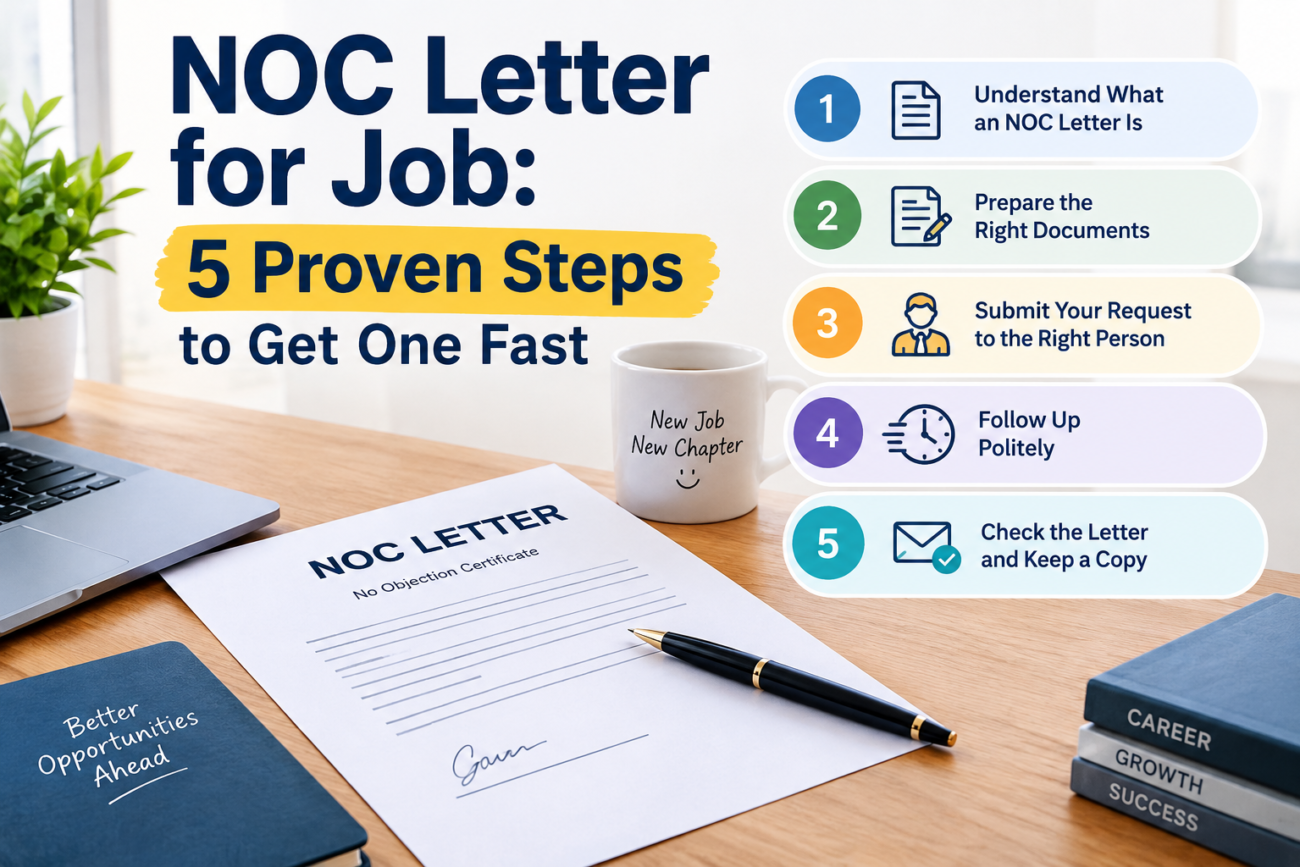
1. I asked before formally resigning, not after. This felt risky, but my new employer’s timeline required it. I framed the conversation carefully, letting my manager know I had an opportunity I was seriously considering and needed documentation to move forward, rather than presenting it as a done deal.
2. I put the request in writing, even after the verbal conversation. A quick, polite email to HR summarizing what I needed and why created a paper trail, which turned out to matter later when the process stalled and I needed to follow up with something concrete to reference.
3. I specified exactly what the letter needed to say. My new employer had specific requirements, confirmation that I had no active bond or bonded commitment preventing me from joining elsewhere. I shared that exact wording with my current HR team instead of leaving them to guess what “an NOC” should include.
4. I followed up every few days, politely. Given how unfamiliar the process was internally, I found that gentle, consistent follow-up moved things along faster than one request and then silence.
5. I got it before formally resigning wherever possible. Once the NOC letter for job confirmation was issued, I used that clarity to plan my actual resignation timeline properly, rather than juggling both processes at once under pressure.
What Mine Actually Said
When it finally arrived, it was surprisingly short: my name, my designation, confirmation that I had no pending bond obligations related to the sponsored certification, and a line stating the company had no objection to me pursuing employment elsewhere. Four sentences, formally signed and stamped, but those four sentences unlocked my entire onboarding process with the new company.
When You’ll Actually Need One
From my own experience and comparing notes with a few friends who’ve needed this too, an NOC letter for job situations tends to come up specifically when:
- Your current employer sponsored a certification, training, or relocation with a minimum-tenure clause attached
- You’re working in a country with a sponsorship-based employment system, where changing employers requires formal clearance
- You’re in a government or heavily regulated role where switching employers requires documented consent
- Your new employer’s own compliance process specifically requires it as part of background verification
If none of these apply to your situation, you likely don’t need one at all, a standard resignation and relieving letter is usually sufficient for most private-sector job changes.
Common Mistakes People Make
- Assuming every job change requires an NOC, when most standard resignations don’t need one at all.
- Asking vaguely for “an NOC” without specifying exactly what needs to be confirmed in it.
- Waiting until the last minute, when internal approval processes, especially at companies without a clear system for this, can take longer than expected.
- Not getting the request in writing, relying only on a verbal conversation that’s harder to follow up on later.
- Confusing an NOC with a relieving letter, and requesting the wrong document from HR entirely.
A Mistake I Nearly Made
I almost asked for my NOC letter for job purposes through a casual Slack message to my manager, treating it like a minor administrative ask. A colleague who’d been through a similar process advised me to send a proper email instead, given how unfamiliar the process was at our company. That turned out to be the right call, since the email became the actual reference point HR used internally to process my request.
How This Fits Into Your Bigger Exit Timeline
If you’re navigating an NOC letter for job purposes alongside an actual resignation, it helps to already understand how the rest of your exit paperwork typically works, since these processes often overlap. Our guide on notice period buyout covers a related situation, when timing pressure from a new employer means negotiating your exit terms directly rather than just requesting a clearance document.
Final Thoughts
Needing an NOC letter for job switching caught me off guard, mostly because I’d never encountered the requirement before and assumed my new employer was asking for something unusual. It wasn’t unusual, it was just unfamiliar to my specific situation.
Ask early, be specific about what the letter needs to confirm, put the request in writing, and follow up consistently if your company doesn’t have an established process for it. It’s a short document, but it can hold up an entire job transition if you leave the request too late or too vague.
For a broader look at how employment clearance documents and job transitions typically work, see Indeed’s overview of resigning from a job professionally.
