
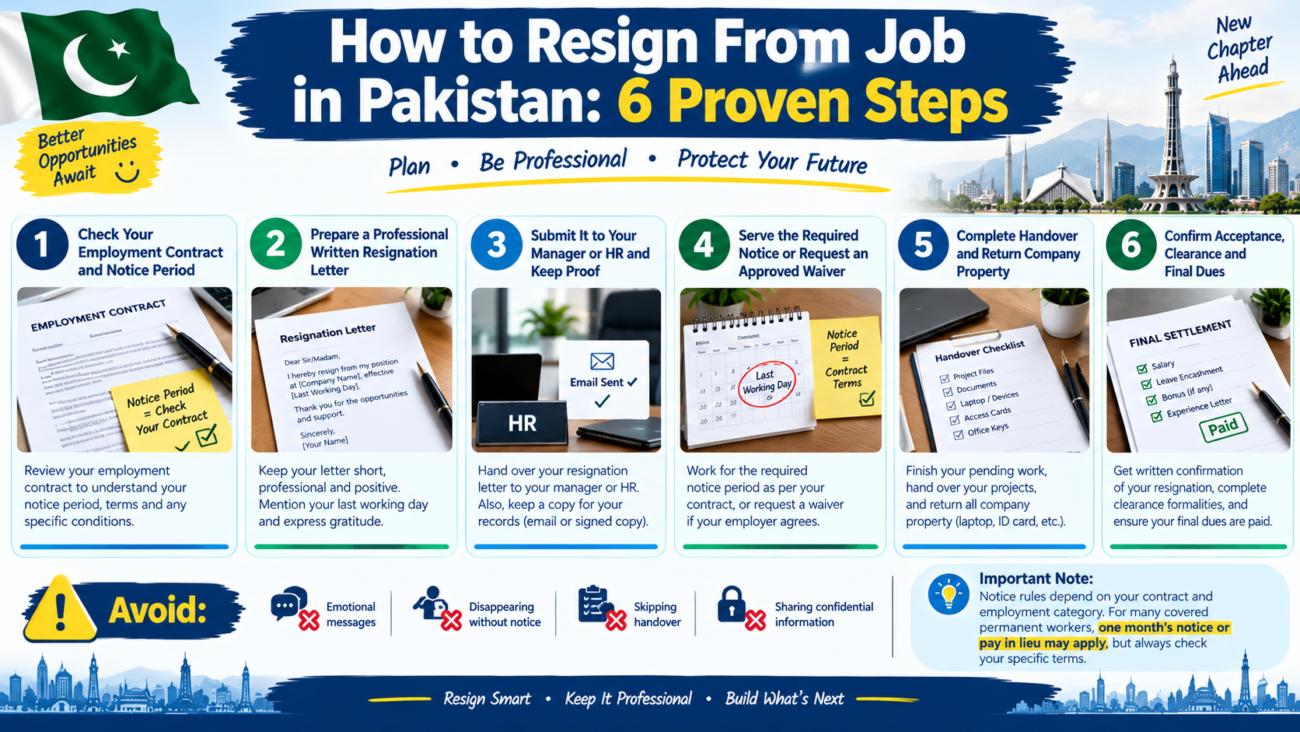
How to Resign From Job in Pakistan: 6 Proven Steps, Every Document Explained
I’ve now been through the resignation process a few times, and every single time, I’ve had to relearn something I’d forgotten from the last one. If you’re searching for how to resign from job in Pakistan the right way, this guide walks through every single step, in order, so you don’t have to piece it together the hard way like I did.
This guide is the missing map. It’s not a replacement for the detailed guides on each individual step, think of it as the page that shows you where each step fits, and in what order things actually happen.
How to Resign From Job in Pakistan: The Real Order Things Happen In
Resigning isn’t one event, it’s a sequence, and the order matters more than people expect. Here’s roughly how how to resign from job in Pakistan plays out for most private-sector roles:
- You decide to resign and hand in your notice
- You serve your notice period, or negotiate to shorten or buy it out
- You may need an NOC if your job has any sponsorship, bond, or restriction attached
- You receive your relieving letter and, separately, your experience letter
- Your full and final settlement gets processed
- You walk away with your documents filed and your dues settled
Each of these steps has its own quirks, timelines, and ways to go wrong, which is exactly why I’ve written separate detailed guides for each one.
Step 1: Writing and Submitting Your Notice
This is where it all starts, and getting the tone and timing right sets the pace for everything that follows. Most companies expect a formal written notice, not just a verbal heads-up in a meeting.
Read next: How to write a two weeks notice letter
Step 2: Handling Your Notice Period (Or Shortening It)
Sometimes your notice period lines up fine with your new job’s start date. Sometimes it doesn’t, and you need to either negotiate it down or pay your way out of the remaining days.
Read next: Notice period buyout
Step 3: Getting an NOC, If You Need One
This step doesn’t apply to everyone. If your job involved a sponsored certification, a bond, or you’re in a sponsorship-based employment setup, you may need formal clearance before your new employer will finalize anything.
Read next: NOC letter for job
Step 4: Understanding What Documents You’ll Actually Receive
This is where most of the confusion happens, mostly because so many of these documents sound similar but serve completely different purposes. Your relieving letter, your experience letter, and any warning or show cause documentation from earlier in your tenure all matter for different reasons.
Read next: Experience letter vs relieving letter
If your exit followed any disciplinary process, it’s worth understanding the difference between the documents involved there too.
Read next: Warning letter vs termination letter and Show cause notice vs warning letter
Step 5: Getting Your Full and Final Settlement
This is the last financial step, and it’s rarely as fast as people expect. It covers your final pay, any leave encashment, and settles anything you owe the company too.
Read next: Full and final settlement
A Realistic Timeline for How to Resign From Job in Pakistan
One thing that makes how to resign from job in Pakistan confusing is the timeline itself, since it rarely matches what people expect going in. Based on my own experience and comparing notes with others who’ve gone through this, here’s a rough sense of how long each stage tends to take:
- Notice period: whatever your contract states, typically 30 to 60 days, though this can be negotiated
- NOC processing, if needed: anywhere from a few days to a couple of weeks, depending on how established your company’s process is
- Relieving and experience letters: usually issued on or shortly after your last working day, though experience letters sometimes require a separate request
- Full and final settlement: commonly takes several weeks after your last working day, sometimes longer if multiple departments need to sign off
Common Mistakes Across the Whole Process
- Assuming every step happens automatically without you needing to ask
- Not requesting documents specifically by name, and accepting whatever HR hands over without checking it matches what you actually need
- Making financial plans based on verbal promises instead of documents you’ve actually seen in writing
- Not keeping your own copies of everything, scanned and organized, before you hand back your laptop and badge
- Treating the process as a single event instead of a sequence with its own realistic timeline
Final Thoughts
Knowing how to resign from job in Pakistan properly isn’t just about a graceful notice letter and a good last conversation with your manager. It’s a multi-step process with its own paperwork, its own timeline, and its own ways of going sideways if you’re not paying attention.
Work through each stage in order, use the detailed guides linked above when you get to that specific step, and don’t assume silence means either good news or bad news, ask directly when something feels unclear. Every one of these steps gets easier once you know what to actually expect from it.
For a broader look at how resignation and notice periods work in general, see Indeed’s guide to resigning from a job professionally.
