
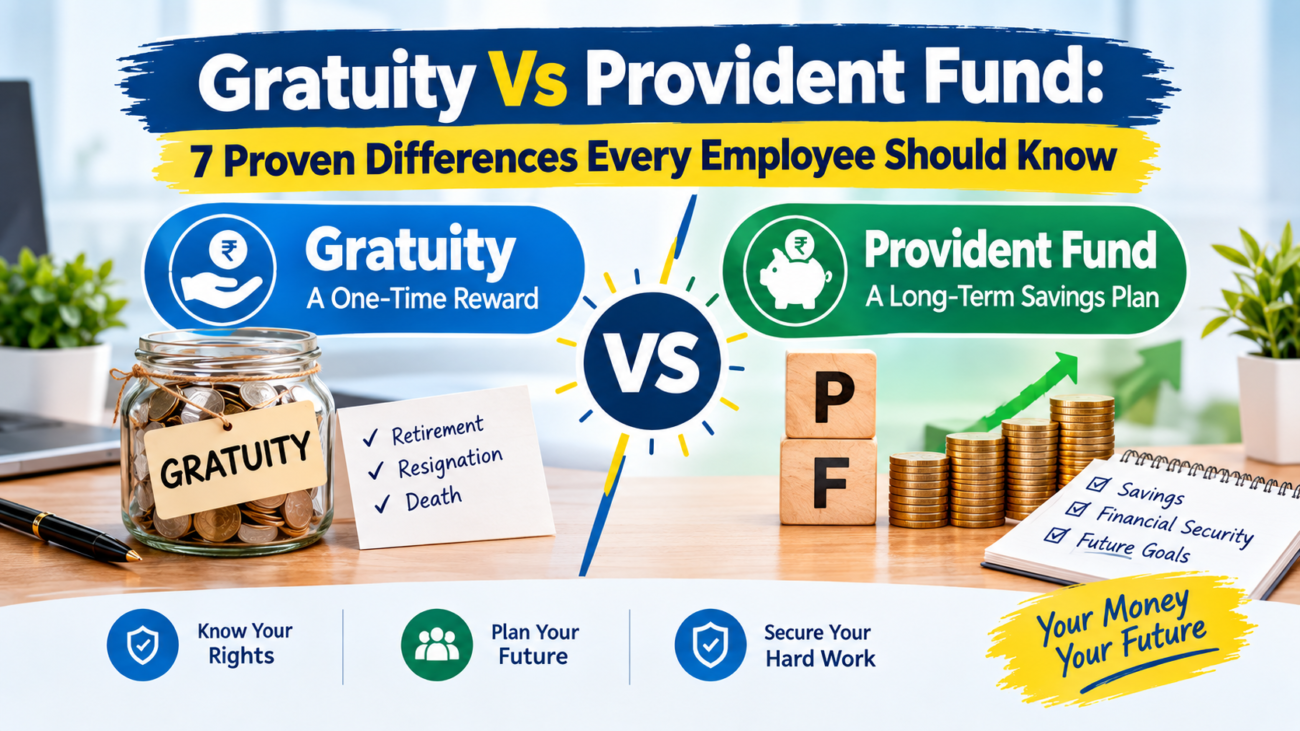
Gratuity Vs Provident Fund: 7 Proven Differences Every Employee Should Know
A few years into my first corporate job, HR sent out an email asking everyone to “update your PF nominee details.” I had no idea what that meant. Then, a senior colleague who was leaving the company mentioned he was getting his “gratuity amount” processed along with his final salary. Two different terms, both clearly about money I was somehow owed, and I genuinely had no clue what separated one from the other.
I did what most of us do — nodded along like I understood, then went home and quietly googled it. What I found online was either too technical or too vague to actually help. So here’s the plain-English version of gratuity vs provident fund I wish someone had handed me that day, based on everything I’ve learned since from payslips, HR conversations, and a few costly assumptions.

The Short Version First
If you only remember one line from this article, let it be this: gratuity vs provident fund basically comes down to who’s paying and when you get it.
Gratuity is a lump sum your employer pays you, usually only when you leave the company after a certain minimum period of service. Provident fund, on the other hand, is a savings pool that both you and your employer contribute to regularly, every single month, throughout your employment.
One builds up quietly in the background from day one. The other only shows up as a reward near the end of your journey with that employer.
My First Real Encounter With This Confusion
When I resigned from a job after almost four years, I assumed I’d get both my provident fund balance and a gratuity payout automatically, bundled together in my final settlement.
What actually happened was messier. My provident fund amount came through fine because I had been contributing to it every month and could see the balance growing on my payslips the whole time. But gratuity wasn’t something I had been “watching” build up, so when the number came on my final settlement, I had zero idea if it was calculated correctly.
That’s when I realized the gratuity vs provident fund difference isn’t just definitions — it directly affects how much money you walk away with, and whether you can even verify it yourself.
Breaking Down Gratuity Vs Provident Fund Properly
Provident Fund (PF):
- Both employee and employer contribute a percentage of basic salary every month
- It’s essentially a forced savings account for your retirement or future use
- You can usually track your own contribution on your monthly payslip
- In many companies, you can withdraw it (or transfer it) when you change jobs
Gratuity:
- Funded entirely by the employer, not deducted from your salary
- Paid as a one-time lump sum, typically when you leave after completing a minimum service period (commonly a few years, depending on company policy and local labor law)
- Calculated based on your last drawn salary and total years of service
- You generally cannot access it while still employed
Why This Difference Actually Matters To You
Here’s where gratuity vs provident fund stops being a textbook topic and starts affecting real decisions.
If you’re comparing two job offers and one company mentions “PF benefits” while the other mentions “gratuity benefits,” they’re not interchangeable. A company offering only provident fund means you’re essentially saving your own money (plus a match) — you’ll always get that amount regardless of why you leave. Gratuity depends heavily on completing a minimum tenure, so if you’re someone who switches jobs frequently, you might never actually qualify for it at several employers in a row.
I learned this the hard way when I left a job just two months short of the minimum gratuity eligibility period at that company. I didn’t lose my provident fund, obviously, since that was always mine. But the gratuity I had mentally counted on simply never materialized, because I hadn’t checked the eligibility timeline properly.
Step-By-Step: How To Actually Check Your Own Situation
- Pull up your appointment letter or HR policy document. Look specifically for a “Gratuity” or “End of Service Benefits” clause, and separately for a “Provident Fund” or “PF” clause. Some companies only offer one, not both.
- Check your monthly payslip for a PF deduction line. If you see a consistent percentage being deducted (and usually matched by the employer), that confirms an active provident fund.
- Ask HR directly for the minimum service period required for gratuity eligibility. Don’t assume it’s the same across companies — it genuinely varies.
- If you’re planning to resign, calculate the date carefully. A difference of even a few weeks can mean qualifying or not qualifying for gratuity.
- Request a written breakdown during your final settlement, showing PF and gratuity as two separate line items, not one combined number. This makes it much easier to verify both are correct.
A Mistake I See Often (Not Just Myself)
A friend of mine assumed her provident fund contributions already “included” gratuity, since both felt like retirement-adjacent benefits in her head. She was shocked during her exit interview to learn gratuity was a completely separate calculation that her company didn’t even offer, since their written policy only covered provident fund.
This mix-up is incredibly common, mainly because both benefits sound similar in casual conversation — something to do with money you get “later.” But legally and financially, gratuity vs provident fund are structured completely differently.
Common Mistakes To Avoid
- Assuming every company offers both gratuity and provident fund — many only offer one.
- Not checking the minimum service period before planning your resignation date.
- Treating your PF balance and gratuity amount as one combined number without verifying each separately.
- Forgetting that PF is partly your own money (contributed from your salary), while gratuity is entirely employer-funded.
- Not asking for a written statement of both benefits before signing an appointment letter.
Where This Connects To Your Final Settlement
If you’re already at the stage of leaving a job, it’s worth understanding how gratuity and provident fund actually show up in your paperwork. I’ve gone into more detail on exactly how final payments are structured in my Full and Final Settlement guide, which pairs well with this topic since both amounts typically get released around the same time.
For a more general, globally-applicable explanation of how provident funds work as a savings mechanism, Investopedia’s overview is a solid reference if you want the broader financial context beyond just the South Asian employment setup.
My Honest Take
Nobody explains gratuity vs provident fund clearly when you join a company — it’s buried in HR policy documents that most of us skim past on day one. But understanding it properly, early on, means you won’t be caught off guard during resignation, retirement, or final settlement like I was. Check your payslip, ask HR the direct questions, and don’t assume both benefits exist just because one does.

One thought on “Gratuity Vs Provident Fund: 7 Proven Differences Every Employee Should Know”