
Rozee.pk Vs LinkedIn for Job Search Pakistan: What Actually Worked for Me
I spent almost three months applying to jobs through Rozee.pk with barely any real responses, just automated “your application has been received” emails that went nowhere. Meanwhile, a friend of mine landed an interview within two weeks purely through a LinkedIn message to a hiring manager. I remember feeling genuinely confused about why the same effort was producing such different results on two platforms that are both supposedly built for the same thing.
That gap is exactly why I want to walk through Rozee.pk vs LinkedIn for job search Pakistan properly, based on actually using both for a real job hunt, not just comparing feature lists.
Why They’re Not Actually the Same Tool
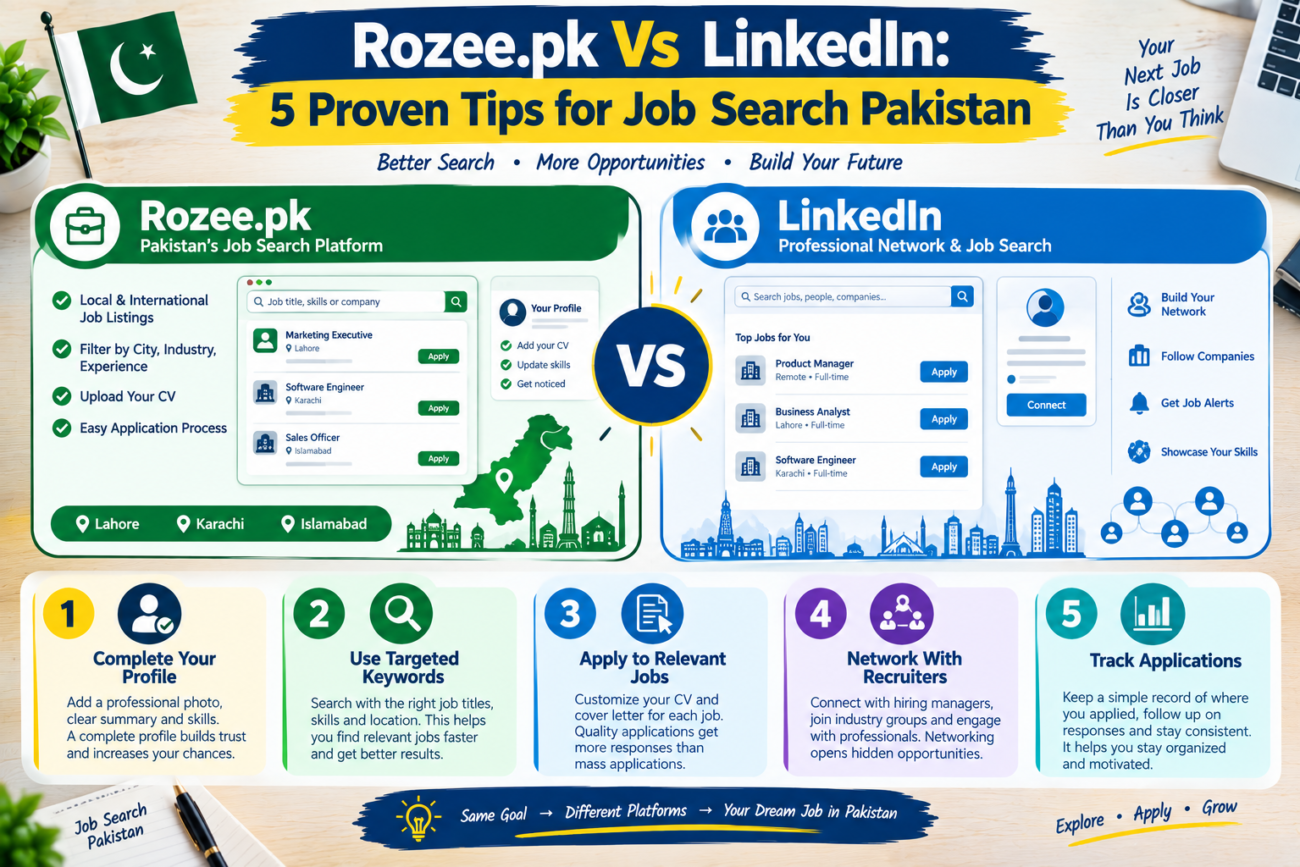
If you’re comparing Rozee.pk vs LinkedIn for job search Pakistan right now, the biggest thing to understand is that they’re not built for the same kind of effort. Rozee.pk is built around applications. You create a profile, upload your CV, and apply to postings directly. It’s structured, familiar, and feels like a traditional job portal because that’s exactly what it is.
LinkedIn is built around relationships. Yes, you can apply to job postings there too, but the platform’s real strength is being found, messaged, and recommended, not just submitting an application into a queue.
Once I stopped treating them as interchangeable and started using each one the way it’s actually designed to work, my results changed noticeably.
What My Rozee.pk Experience Actually Looked Like
I applied to probably 40 to 50 listings over those three months. Most were mid-level marketing roles, a mix of local companies and a few multinationals with Pakistan offices. The application process itself was straightforward, sometimes almost too fast, a few clicks and you’re done.
The problem wasn’t the platform’s usability. It was volume. Popular listings on Rozee.pk get flooded, and without something that makes your application stand out immediately, like a referral or a very specific keyword match, you’re genuinely just one CV among hundreds sitting in an HR inbox.
What did work eventually: smaller, less popular company listings, and roles posted very recently, within the first day or two of going live, before the applicant count exploded.
What My LinkedIn Experience Actually Looked Like
I’d been mostly passive on LinkedIn before this, an occasional post, a mostly-complete profile. Once I got more intentional, actually commenting on posts in my industry, connecting with people at companies I was interested in, and sending short, specific messages to hiring managers, things shifted.
The message that actually worked for my friend, and one I later adapted for myself, wasn’t a generic “I’m interested in opportunities at your company.” It was specific: referencing an actual open role, a specific reason I was a fit, and a short, genuine compliment about something the company had recently done. That kind of message gets read. A cold application into a portal often doesn’t get read by an actual person until much later, if at all.
Step-by-Step: How I’d Use Both Together Now
1. Use Rozee.pk for volume and structure, especially for roles with clear, standard qualifications. Government-adjacent roles, structured corporate positions, and roles where the qualifications are checkbox-style tend to do fine through a straightforward application.
2. Use LinkedIn for anything where a personal connection could matter. Startups, growing companies, and roles where culture fit and initiative matter more than a checklist benefit enormously from being proactively found or reaching out directly.
3. Apply on Rozee.pk within the first 24 hours of a posting going live. I started checking daily instead of weekly, and the difference in response rate for fresher listings was noticeable.
4. On LinkedIn, message before or right after applying, not weeks later. A short note to the hiring manager or recruiter referencing your actual application, sent the same day, made a real difference compared to applying and just waiting silently.
5. Keep your LinkedIn profile as complete as your Rozee.pk CV. I’d neglected my LinkedIn profile for months while keeping my Rozee.pk CV updated. Once I brought both up to the same standard, recruiters actually found me through LinkedIn search without me applying to anything at all.
A Mistake I Made Early On
I used the exact same generic CV and cover letter across every single Rozee.pk application, assuming volume would eventually pay off. It didn’t, not because the CV was bad, but because it wasn’t tailored to anything specific. Once I started adjusting even just the top summary section for each application, matching language from the actual job posting, my response rate improved noticeably, even on the same platform, using the same overall approach.
When Each Platform Genuinely Wins
Rozee.pk tends to win for:
- Entry-level and mid-level roles at traditional Pakistani companies
- Structured, qualification-based hiring processes
- Roles where a direct application is expected and normal
LinkedIn tends to win for:
- Roles at startups, multinationals, or companies with an active hiring presence there
- Any situation where a warm introduction or direct message could help
- Building visibility over time, even when you’re not actively applying anywhere
Common Mistakes People Make
Comparing notes with a few friends who’ve also weighed Rozee.pk vs LinkedIn for job search Pakistan, the same mistakes keep showing up.
- Using the exact same generic CV and application message across every listing on Rozee.pk without any tailoring.
- Treating LinkedIn purely as a job board instead of using its actual strength, direct outreach and visibility.
- Ignoring LinkedIn profile completeness while over-investing time in Rozee.pk CV formatting.
- Applying to popular listings days after they go live, when the applicant pool has already grown significantly.
- Never following up or messaging anyone directly, on either platform, and just waiting passively for a response.
Building the Foundation That Works on Both
Whichever platform you’re leaning on more, having a strong LinkedIn presence specifically still matters even if most of your applications happen through Rozee.pk, since recruiters increasingly check both. If you haven’t already optimized your profile properly, our guide on building your LinkedIn presence covers exactly what to fix first.
Final Thoughts
Rozee.pk vs LinkedIn for job search Pakistan isn’t really a competition where one wins outright. They’re built for different kinds of effort, one rewards volume and structure, the other rewards visibility and direct outreach.
Use Rozee.pk for roles that fit a standard application process, and treat LinkedIn as a relationship-building tool rather than just another portal to submit CVs into. Once I stopped expecting the same approach to work identically on both, my actual results, not just my application count, started improving.
For a broader look at how job search platforms function differently across markets, see Indeed’s general guide to job searching online.

2 thoughts on “Rozee.pk Vs LinkedIn for Job Search Pakistan: 5 Proven Tips”