
Internship Certificate Vs Experience Letter: What You Actually Need When You Leave
My internship ended on a Friday, and my supervisor handed me a nicely designed certificate with the company logo, my name in a fancy font, and a signature at the bottom. I framed it, genuinely proud, and posted it on LinkedIn. Three weeks later, applying for my first real job, the HR person asked for my “experience letter for the internship period.” I sent her a photo of my framed certificate. She replied asking for the actual letter, not the certificate.
That’s when I learned the internship certificate vs experience letter difference the hard way, standing in my room wondering why a document I’d literally hung on my wall wasn’t the one anyone actually wanted for verification purposes.
Why These Get Mixed Up Constantly
If you’ve just finished an internship and you’re googling internship certificate vs experience letter trying to figure out which one you actually need, you’re in the exact spot I was in. Both documents mark the end of the same internship. Both come from the same company, sometimes even signed by the same person. Both feel like proof that you did the work. The confusion is completely understandable, especially if you’ve never had to use either one for anything beyond posting it online.
But they’re built for different purposes, and once you see that clearly, you stop assuming one can substitute for the other.
The Actual Difference
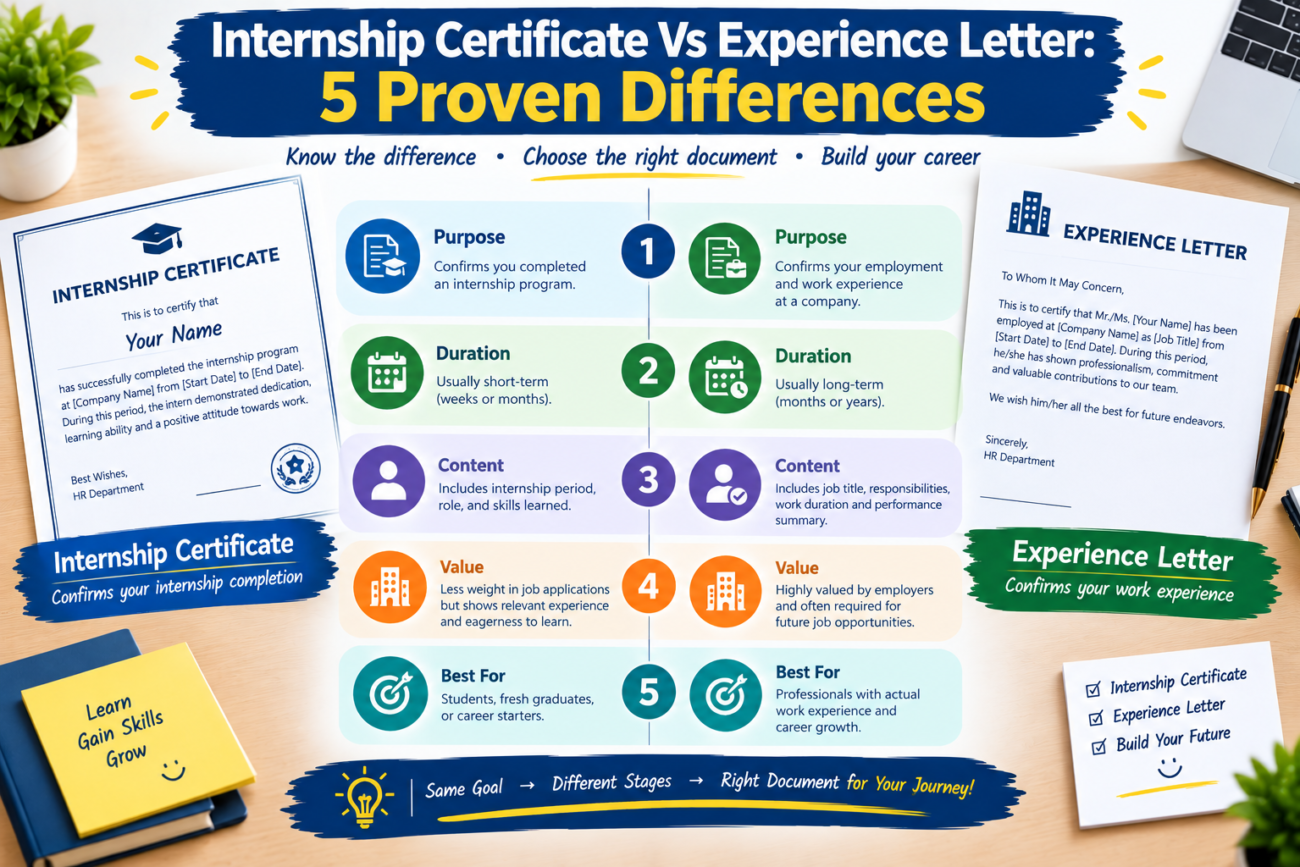
An internship certificate is ceremonial. It confirms you completed a structured program, usually with a nice design, your name, the program title, and the duration. It’s meant to be displayed, shared, and looked at.
An experience letter is functional. It’s a plain, official document, usually company letterhead with no decorative design, confirming your role, responsibilities, and the exact dates you worked there. It’s meant to be verified, filed, and referenced by whoever needs proof of your work history.
Once you separate them that way, internship certificate vs experience letter stops being confusing. One is for showing people. The other is for proving something to an institution.
What Each One Actually Contains
My internship certificate had: my name, the company logo, “Marketing Intern,” the dates, and a line saying I’d “successfully completed the internship program.” That’s genuinely it. Nice to look at, thin on detail.
The experience letter I eventually requested and received had: my full role title, a description of what I actually worked on (social media campaigns and basic content writing, in my case), my exact start and end dates, and a line confirming I was in good standing when I left. It looked far less exciting, plain black text on letterhead, but it’s the document that actually got accepted during my job’s background verification process.
Why This Matters More Than It Seems
When I applied for my first full-time role, HR specifically needed to verify my internship as part of my work history check. They didn’t ask for the certificate at all. They wanted the experience letter because it had the specific details, dates, role, responsibilities, that could actually be cross-checked with the company if needed.
A framed certificate, no matter how nice it looks, doesn’t have the specific verifiable details an employer’s HR team actually needs. This is the exact gap in the internship certificate vs experience letter comparison that caught me off guard.
Step-by-Step: What To Do Before Your Internship Ends
1. Ask specifically for both documents, by name, before your last day. I only got my certificate automatically. I had to specifically request the experience letter afterward, and it took over a week to arrive because nobody had prepared it in advance.
2. Confirm what the experience letter will include. When I requested mine, I asked that it specifically mention my actual responsibilities, not just my title, since a generic one-liner wouldn’t have said much about what I’d actually done.
3. Double-check the dates match your actual start and end dates. Mine were correct, but a friend of mine had her experience letter list the wrong end date, off by two weeks, and had to get it corrected before she could use it during a background check.
4. Get both in a format you can actually submit digitally. My certificate was a nicely designed PDF, easy to share. My experience letter initially only existed as a signed physical copy, and I had to scan it properly before I could email it anywhere.
5. Keep them in separate, clearly labeled folders. I now keep a “Certificates” folder for anything I’d show off and a “Verification Documents” folder for anything an employer might actually need to check, experience letters, relieving letters, and similar paperwork.
A Mistake I Made
I assumed my internship certificate alone would be enough proof when I first mentioned the internship on a scholarship application months later. It wasn’t. The scholarship committee specifically wanted a letter confirming my role and responsibilities, not just a certificate confirming attendance. I had to go back to my old supervisor, months after leaving, to request the experience letter I should have gotten right away.
Lesson learned: request the experience letter immediately when your internship ends, even if you don’t think you’ll need it yet. Getting it later, once your supervisor has moved on to other things or forgotten details, is a much slower process.
When You’ll Actually Need Each One
The internship certificate is genuinely useful for:
- Sharing on LinkedIn or social media
- Academic submissions where a completion certificate is specifically requested
- Portfolio pieces showing structured program completion
The experience letter is genuinely useful for:
- Background verification at your next job
- Proving work history for visa or scholarship applications
- Building a case for relevant experience when you don’t have much full-time work history yet
Common Mistakes People Make
I’ve seen the same internship certificate vs experience letter mix-ups come up again and again, both in my own case and comparing notes with other interns.
- Assuming the internship certificate can substitute for an experience letter during background checks.
- Not requesting the experience letter until months later, when it’s harder to get accurate details included.
- Not checking that the dates and role description are accurate before filing the document away.
- Only keeping a physical copy without a scanned digital version ready to send.
- Forgetting to ask what happens if the company doesn’t automatically issue an experience letter for interns, some only do this for full-time employees unless you specifically ask.
Where This Fits Into Building Your Career Documents
If this is your first internship and you’re still building out your resume with limited work history, it’s worth working through how to write a resume with no experience, since knowing how to frame internship experience properly on paper matters just as much as having the right documents to back it up.
Final Thoughts
My framed certificate still hangs on my wall, and I don’t regret getting it. But the internship certificate vs experience letter mix-up taught me that the document worth chasing down before you leave isn’t always the one that looks the most impressive.
Ask for both, understand what each is actually for, and don’t assume a nicely designed certificate will do the job an official experience letter is built for. One’s for showing people what you accomplished. The other is for proving it.
For a broader look at how employers typically verify internship and early work experience, see Indeed’s career advice on internships.
