
Full and Final Settlement: What I Wish Someone Had Told Me Before I Resigned
My last paycheck took 52 days to arrive. Fifty-two. I’d budgeted like it would show up within a week of my last working day, because that’s what I assumed “getting your dues” meant. Instead, I spent almost two months following up with an HR inbox that kept saying “it’s in process.”
That entire mess was my first real introduction to this side of leaving a job, and nobody at any job I’d had before that had ever sat me down and explained what it actually involves, how long it takes, or what I should be checking before I sign off on it.
If you’ve just resigned, gotten laid off, or you’re planning your exit and keep hearing “your FnF will be processed,” this is the conversation I wish someone had had with me first.

What Full and Final Settlement Actually Covers
In plain terms, full and final settlement is the last financial transaction between you and your employer. It’s not just your last month’s salary. It’s everything owed to you, and sometimes things you owe back to the company too, all bundled into one final number.
When my HR finally sent the breakdown, it included my pending salary, my unused annual leave encashed into cash, and a small pending bonus from a project I’d finished two months earlier. It also had a deduction I hadn’t expected, for a laptop bag the company had issued that I apparently never returned. I’d genuinely forgotten I still had it.
That’s the real shape of this process: it’s not one clean number, it’s a mix of what they owe you and what you might owe them, netted out into a final figure.
Why It Takes So Long (And Why That’s Somewhat Normal)
I assumed my settlement would land within a week, similar to a regular payday. It doesn’t work that way almost anywhere. Full and final settlement usually requires clearance from multiple departments: HR needs to confirm your leave balance, Finance needs to calculate everything, IT needs to confirm all company equipment came back, and sometimes your manager needs to sign off that you completed your handover.
Every one of those departments moving at its own pace is exactly why my 52-day wait happened. Nobody was being malicious, they were just slow, and I hadn’t followed up early enough to keep the whole thing moving.
What Usually Gets Included
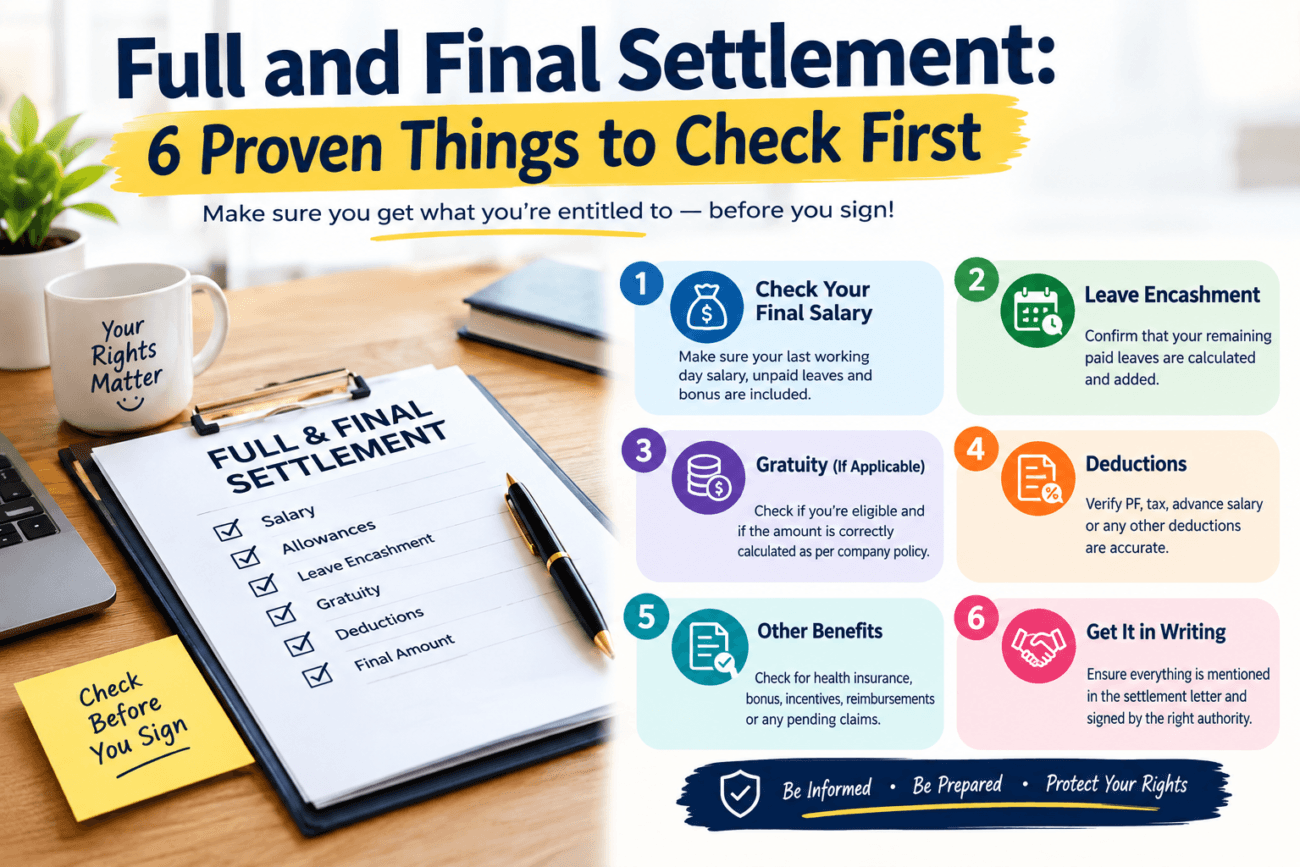
Based on my own experience and comparing notes with a few friends who went through the same process at different companies, here’s what typically shows up in a full and final settlement:
- Your salary for any days worked in your final month that hadn’t been paid yet
- Encashment for unused annual leave, if your company policy allows it
- Any pending bonus, commission, or incentive you’d already earned
- Provident fund or gratuity payout, depending on your country and how long you worked there
- Deductions for any company property not returned, laptops, ID cards, security deposits, that laptop bag in my case
- Deductions for any loans or advances you’d taken from the company that weren’t fully repaid
Step-by-Step: What I’d Do Differently Next Time
1. Ask for the settlement timeline in writing before your last day. I never asked this directly, which is exactly why I had no idea whether 52 days was normal or a red flag. A simple “what’s the expected timeline for my full and final settlement?” email to HR sets a benchmark you can actually follow up against.
2. List every piece of company property you have, and return it early. Don’t wait until your last day to remember the laptop bag, the extra monitor, or the access card. I’d genuinely forgotten about mine, and it delayed my own settlement by holding up the IT clearance step.
3. Check your leave balance yourself before HR does. I trusted their number blindly. A friend of mine actually caught a discrepancy in her own leave balance because she’d kept her own tracker, and it added a decent amount back to her final payout once corrected.
4. Get the settlement breakdown in writing, not just a lump sum. When the number finally came through, I almost didn’t ask for the itemized breakdown. Always ask for it. You want to see exactly what’s included and what’s deducted, not just a final total you have to trust blindly.
5. Follow up every two weeks, politely but consistently. Silence doesn’t mean progress. A short, polite check-in email every couple of weeks kept my case from disappearing into someone’s inbox entirely.
A Mistake That Cost Me Time
I signed my final settlement acknowledgment without actually reading the itemized breakdown carefully. Later, comparing notes with a colleague who left around the same time, I realized my leave encashment number looked lower than expected for the same number of unused days. By the time I noticed, I’d already signed off, and reopening it felt awkward enough that I let it go.
Lesson learned: read every line before you sign, even if you’re exhausted and just want the process to be over.
Common Mistakes People Make
- Assuming full and final settlement will land within days, the same way a regular salary does
- Not tracking your own leave balance, and trusting HR’s number without checking
- Forgetting to return company property, which quietly stalls the entire process
- Signing the settlement acknowledgment without reviewing the itemized breakdown
- Not following up at all, assuming silence means it’s being handled
How This Connects to Your Other Exit Paperwork
Full and final settlement usually happens around the same time you’re also sorting out your relieving letter and experience letter, and it’s easy to get the three tangled together in your head during a busy exit period. If you haven’t already, it’s worth understanding how those two documents differ from each other, since our guide on experience letter vs relieving letter walks through exactly that confusion.
Final Thoughts
Leaving a job well isn’t just about a graceful resignation letter and a clean handover. The financial side, your full and final settlement, deserves the same attention, and it’s the part most people walk into completely unprepared for.
Ask early, track your own numbers, return company property before it’s asked for twice, and read the breakdown before you sign anything. It won’t necessarily make the process faster, some of that genuinely depends on how organized your employer’s departments are, but it will mean you’re not caught off guard by a 52-day wait and a mystery deduction for a laptop bag you forgot you had.
Final pay rules and processes vary a lot by country and company policy — for a sense of how differently this works elsewhere, Nolo’s overview of final paycheck rules is a useful comparison point, even though the exact terminology differs from region to region.

One thought on “Full and Final Settlement: 6 Proven Things to Check First”