
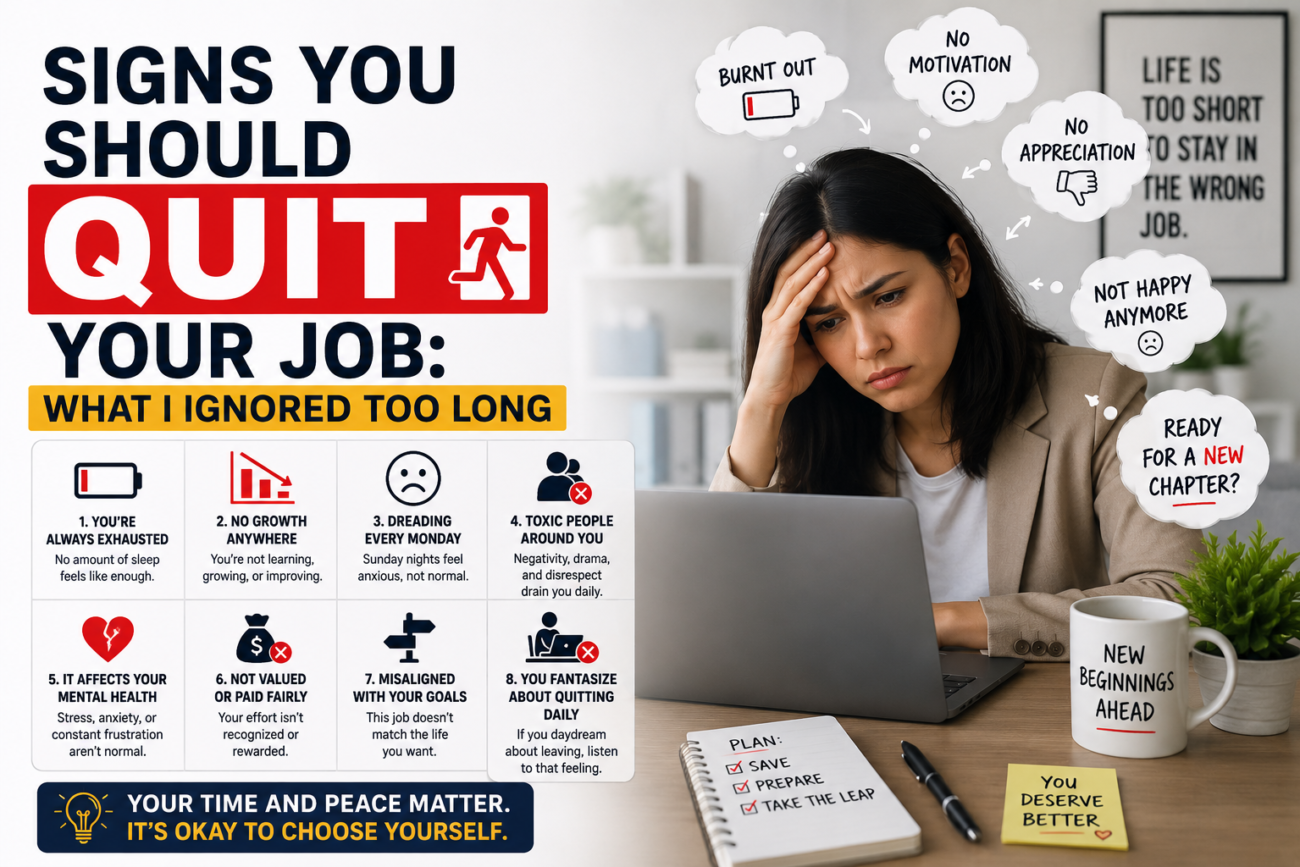
Signs You Should Quit Your Job: What I Ignored for Way Too Long
I stayed in a job for almost a year after I already knew, deep down, that I should’ve left. Not because I didn’t see the signs you should quit your job, I saw plenty of them, I just kept explaining each one away individually instead of looking at the whole picture. “It’s just a rough month.” “Every job has a difficult boss.” “I’ll feel better once this project wraps up.” It never actually wrapped up into feeling better.
If you’re doing that same mental gymnastics right now, reading lists like this one hoping something clicks, here’s what actually made me stop rationalizing and start job hunting for real.
The Sunday Night Feeling Isn’t Normal, Even Though It Feels Common
Everyone jokes about the “Sunday scaries,” so it’s easy to write off as just something everyone deals with. But there’s a real difference between mild “back to work” grumbling and genuinely dreading the next five days starting the moment your weekend ends.
For me, it got to the point where I’d start feeling that pit in my stomach around 4pm on Sunday, sometimes earlier. Not because I had a huge presentation or anything specific, just the general existence of Monday. Looking back, that was probably the loudest of all the signs you should quit your job, and I ignored it the longest because it felt too vague to act on.
You’ve Stopped Learning Anything New
This one’s sneaky because it doesn’t feel dramatic in the moment. I noticed I was doing the exact same tasks I’d been doing eighteen months earlier, just faster and with less thought. No new skills, no new tools, nothing that would actually help me if I needed to job hunt.
A friend who works in hiring told me something that stuck with me: if you can’t clearly answer “what have you learned in the last six months at this job” in an interview, that’s often a bigger red flag to employers than an actual gap on your resume. Stagnation shows, and it’s one of the quieter signs you should quit your job because it doesn’t feel urgent until it suddenly does.
Your Health Is Quietly Keeping Score
I want to be careful here, because this isn’t about diagnosing anyone or saying every headache means quit immediately. But I noticed a pattern I couldn’t ignore forever: tension headaches nearly every afternoon, trouble actually falling asleep even though I was exhausted, and a general low-grade stress that didn’t have an obvious cause outside of work.
If your body is consistently reacting to your job in ways it didn’t before, that’s worth paying attention to, and it’s worth talking to an actual doctor about too, not just powering through it. Physical symptoms tend to show up before we’re willing to admit the emotional stuff out loud.
There’s Genuinely No Path Forward Where You Are
I asked my manager directly, twice, over about eight months, what it would take to move into a more senior role. Both times I got a version of “let’s revisit that soon,” and neither time did we actually revisit it.
If you’ve asked directly and gotten vague, non-committal answers more than once, that’s real information, not just bad luck or timing. Some companies genuinely don’t have room to grow you, no matter how good your work is, and that’s not something you can fix from your side of the desk.
You’re Comparing Every Job Posting You See to Your Current One
I started noticing I couldn’t scroll LinkedIn without mentally drafting my resignation letter for every interesting posting I saw. That constant, low-level “wait, could I just leave for that instead” thought loop running in the background is exhausting, and it’s also one of the more honest signs you should quit your job, since your brain already knows something your calendar hasn’t caught up to yet.
Step-by-Step: What I’d Actually Do Differently Now
- Write down the specific reasons, not just the feeling. “I’m unhappy” is hard to act on. “I haven’t had a real project in four months and my last two requests for growth were ignored” is something you can actually use in an interview or a conversation with your manager.
- Have one honest conversation before deciding anything final. I skipped this step out of frustration and later wondered if a direct conversation about my role might have changed things. It might not have, but I never gave it the chance.
- Start quietly updating your resume before you’re desperate. I waited until I was miserable to even open the document, which meant I was job hunting from a place of panic instead of choice. If you’re recognizing these signs you should quit your job, this is the moment to start, not after you’ve already snapped.
- Line up your finances before you give notice. I gave two weeks’ notice with about six weeks of savings, which worked out, but it was closer than I’d have liked. A financial cushion changes the whole tone of a job search from desperate to selective.
- Actually interview around before accepting the first offer. My mistake here was taking the very next offer that came along because I was so ready to leave. It turned out fine, but I got lucky, I didn’t have a real comparison to know if it was actually the better move.
The Mistake That Cost Me Real Time
I told myself for months that quitting without another job lined up was irresponsible, so I kept applying half-heartedly while still fully checked out at my current role. That in-between state, mentally gone but still showing up, was honestly worse than either fully committing to the job search or committing to staying and trying to fix things. If you’re going to leave, actually put real energy into finding the next thing. If you’re going to stay, actually try to fix what’s wrong first. The middle ground where I lived for months just extended the misery.
What Doesn’t Count as a Sign You Should Quit
Not every rough patch means it’s time to go, and it’s worth saying that clearly. A genuinely hard week, a single difficult project, or a temporary staffing shortage that’s making things chaotic isn’t the same as a consistent pattern. According to Indeed’s career advice on this topic, the difference usually comes down to whether the issue is a phase or a pattern that’s lasted months, not weeks. If you can picture things genuinely improving in a reasonable timeframe, it might be worth one honest conversation before deciding anything.
If You Do Decide It’s Time
Once you’re actually ready to start applying, having a resume that reflects your real skills, not just your job title, matters more than people expect. If it’s been a while since you’ve updated yours, how to write a resume that gets you hired covers exactly how to reframe your experience so it actually lands with hiring managers instead of just listing what you did.
Final Thoughts
Looking back, I didn’t need someone to tell me the signs you should quit your job, I needed to stop explaining each one away individually and actually look at the pattern all together. One bad week isn’t a pattern. Dreading Sundays for six months straight, not learning anything new in over a year, and getting vague answers about growth every time you ask, that’s a pattern. Trust it a little sooner than I did.

3 thoughts on “Signs You Should Quit Your Job: What I Ignored Too Long”