
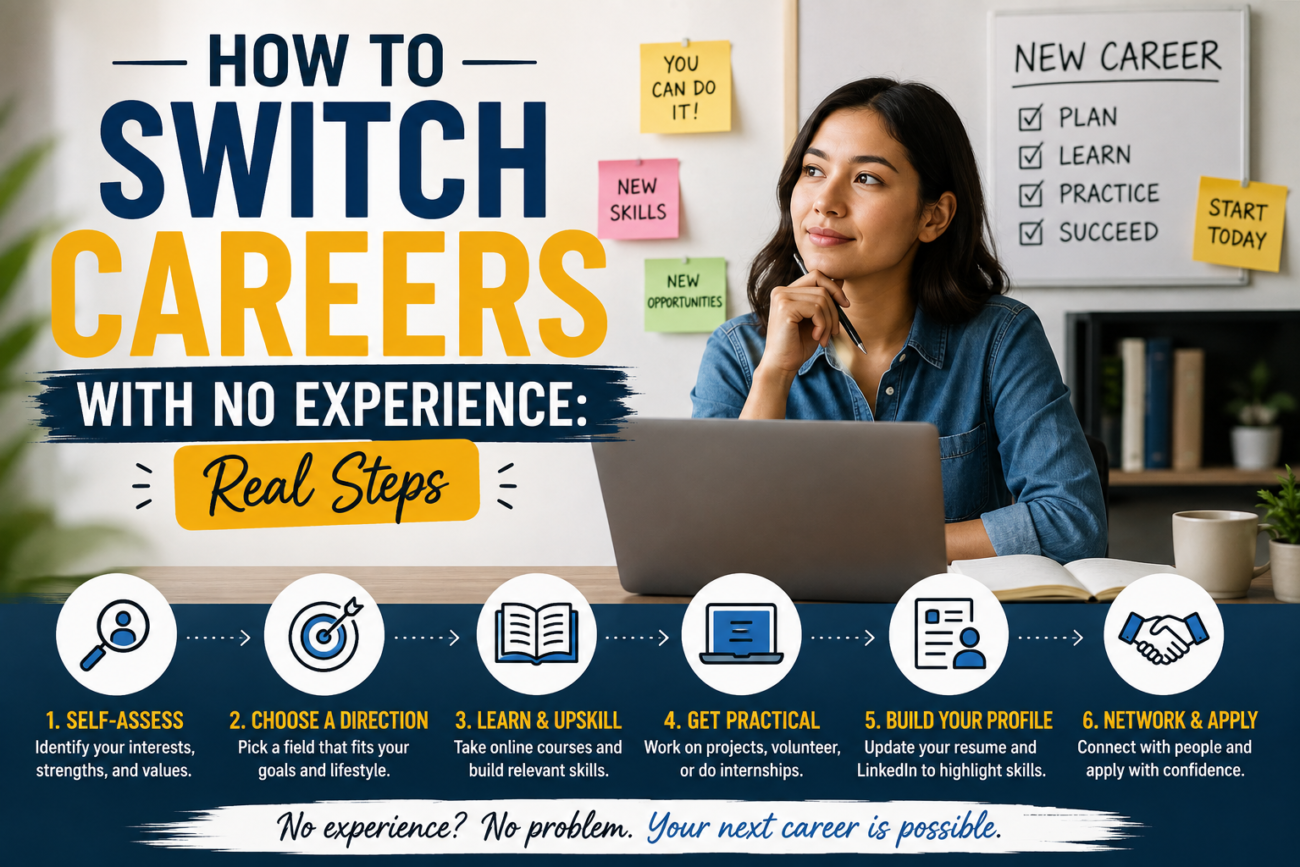
How to Switch Careers With No Experience: What Actually Worked When I Did It
Three years into a job I was decent at but never actually liked, I sat in my car in the parking lot before a shift and thought, genuinely, “I can’t do this for another twenty years.” No plan, no backup savings cushion, just that one uncomfortable thought that wouldn’t go away. If you’re sitting somewhere similar right now trying to figure out how to switch careers with no experience in the field you actually want, I’ve been exactly where you are, and it’s a lot more doable than it feels right now.
This isn’t going to be a motivational speech. It’s what I actually did, what completely backfired, and what I’d tell a friend in the same spot today.

The Fear That Keeps People Stuck Longer Than Necessary
Almost everyone in this position has the same worry on loop: “why would anyone hire me over someone who’s already done this job?” It’s a fair question, and for a while I let it stop me from even applying anywhere.
Here’s what changed my mind. I started noticing how many job postings listed requirements that, when I actually talked to people already in those roles, turned out to be more of a wish list than a hard requirement. Companies post an idealized candidate, then hire the best realistic option that actually applies. That gap between “ideal candidate” and “who they actually hire” is bigger than most people assume.
Step One: Figure Out What’s Actually Transferable
Before touching your resume, sit down and get specific about what you’ve actually built in your current field that applies elsewhere. I came from a customer service background moving into project coordination, and at first I genuinely thought I had nothing relevant.
Turns out, handling escalated customer complaints under pressure, juggling multiple tickets with different priorities, and coordinating between departments to solve problems, that’s project coordination with a different label on it. I just hadn’t been calling it that.
Sit down and write out everything you actually do in a typical week at your current job. Then look at job postings in your target field and see how many of those responsibilities overlap, even loosely. You’ll usually find more than you expect, and this step alone is where most of how to switch careers with no experience actually begins.
Step Two: Close the Real Gap, Not the Imaginary One
Once you know what actually transfers, you’ll also see what genuinely doesn’t. For me, that was specific software knowledge, project management tools like Asana and basic budgeting spreadsheets I’d never touched.
I didn’t go back to school for this. I did a short, cheap online certification through Coursera, spent about six weeks on it during evenings, and built one small sample project I could actually show in interviews. That one project mattered more than the certificate itself, honestly, because it gave me something concrete to talk about instead of just a line on a resume, and it’s the piece most guides on how to switch careers with no experience skip over entirely.
Step Three: Get in Front of Actual People in the Field
This is the part I put off the longest because it felt uncomfortable, and it’s also the part that mattered most. I started reaching out to people already working in project coordination through LinkedIn, just asking for fifteen minutes to hear about their day-to-day work.
Most people said yes. Most people are flattered to be asked, honestly. Out of maybe twelve conversations, one of them mentioned an opening at her company two months later before it was even posted publicly. I wouldn’t have known about it otherwise.
If reaching out cold feels intimidating, keep the message short. Something like:
“Hi [Name], I’m exploring a move into project coordination from a customer service background and would love to hear about your experience in the field, would you have 15 minutes sometime in the next couple weeks?”
That’s it. No need to overthink the wording.
Step Four: Rebuild Your Resume Around the New Direction, Not Your Old Title
This tripped me up initially. I kept leading my resume with my actual job title, which made hiring managers immediately mentally file me under “customer service candidate” before reading further.
Instead, I rewrote my summary section to lead with the transferable skills first, then let the work history explain where they came from. If you’re doing this yourself and aren’t sure how to frame experience that doesn’t look like a traditional match on paper, how to write a resume with no experience covers a lot of the same translation process, just applied to people switching fields rather than starting from zero entirely.
The Mistake That Cost Me Three Months
I applied to about thirty jobs in a row using the exact same resume and cover letter, barely tweaking anything between applications. Almost complete silence. It wasn’t until a friend who actually worked in hiring looked at it and pointed out I was speaking the language of my old field, not my new one, that things started moving.
After I started tailoring each application to mirror the specific language from each job posting, even small phrase changes, response rates went up noticeably within a couple weeks. Painful lesson, but a fast fix once I actually saw it.
What Actually Got Me the Interview
Looking back, it wasn’t a certificate or a perfectly polished resume. It was the sample project I built during that six-week course, paired with being able to speak specifically about one of those informational conversations I’d had. In the interview, I referenced something a contact had mentioned about how her team actually structured their weekly planning, and the interviewer visibly perked up because it showed I’d actually done research beyond the job posting itself.
A Realistic Timeline, Since Nobody Tells You This Part
This whole process, from that parking lot moment to an actual job offer, took about five months. Not five weeks. If you’re expecting overnight results, you’ll get discouraged fast. According to career transition research from Merit America, most entry-level career transitions genuinely take several months of preparation, training, and active job searching, which lines up almost exactly with what I experienced trying to figure out how to switch careers with no experience myself.
Common Mistakes Worth Avoiding
- Applying with a generic resume that still centers your old job title instead of your new direction
- Skipping the networking conversations because they feel awkward, they’re often where the actual opportunities come from
- Trying to close every single skill gap before applying anywhere, you’ll never feel “ready enough” if you wait for that
- Underestimating how long the process realistically takes and giving up around month two
Final Thoughts
Figuring out how to switch careers with no experience isn’t about erasing your old background, it’s about translating it into language your new field actually recognizes, then closing the smallest real gap you can with something concrete to show for it. It took me longer than I expected and felt uncomfortable more than once, especially the networking part. But every uncomfortable email or awkward fifteen-minute call added up to something that a perfect resume alone never would have.
If you’re sitting in your own version of that parking lot moment right now, that discomfort is normal. It doesn’t mean you’re on the wrong path, it just means you’re doing the part of how to switch careers with no experience that most people skip.
