
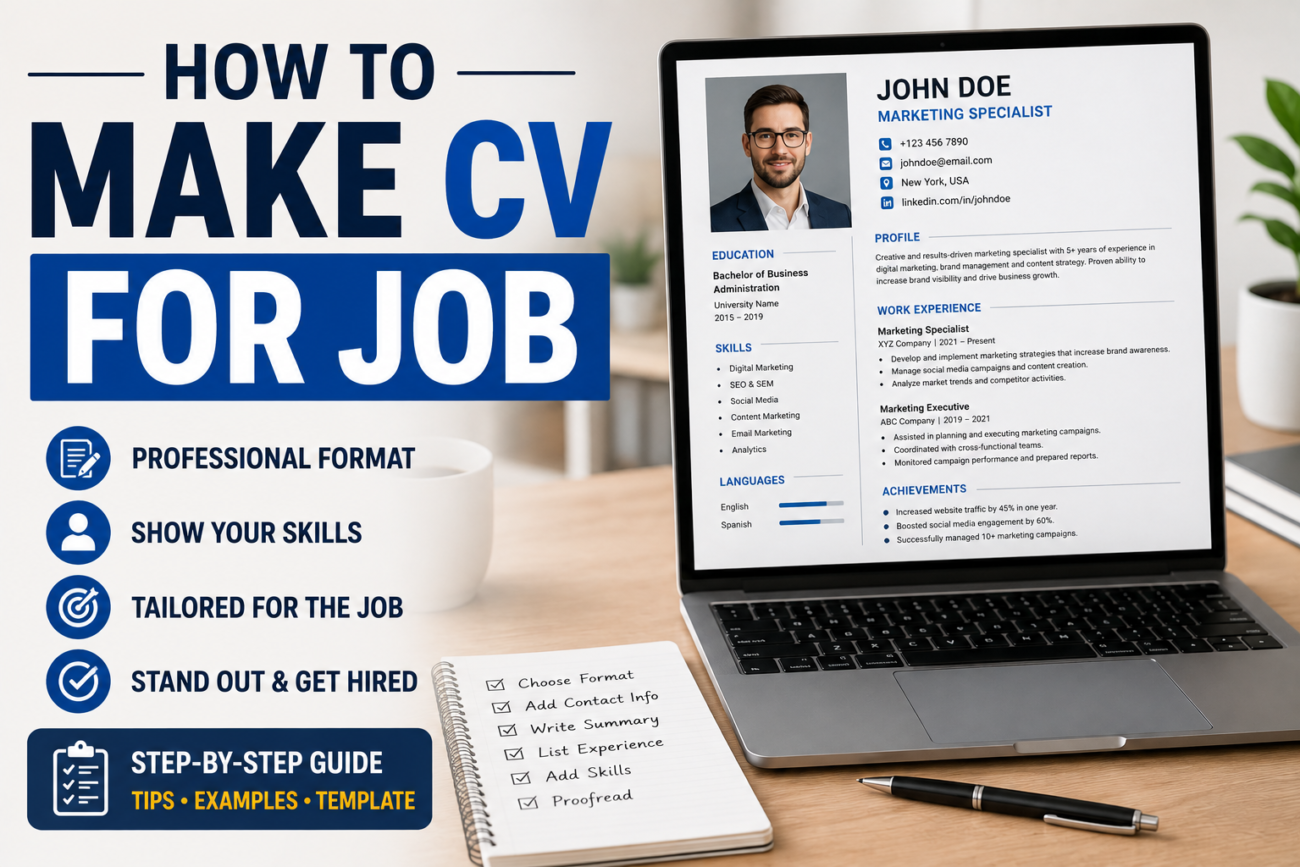
How to Make CV for Job: A Complete, No-Nonsense Guide
Opening a blank document and trying to figure out how to make CV for job applications is one of those tasks everyone puts off until the last possible moment. It feels bigger than it actually is, mostly because nobody really explains what a hiring manager is looking for in the thirty seconds they spend scanning it before deciding whether to keep reading.
Here’s the good news: a strong CV isn’t about fancy design or clever wording. It’s about clarity, structure, and making sure the right information is easy to find fast. Once you understand what actually goes where and why, the whole process gets a lot less intimidating.
What a CV Actually Needs to Do
Before getting into sections and formatting, it helps to understand the real job of a CV. It’s not there to tell your entire life story. It exists purely to get you to the next stage, an interview. That’s it. Every line on the page should be working toward that one goal, and anything that doesn’t support it is just taking up space someone could’ve used to notice your strongest points instead.
Start With Your Contact Information, Kept Simple
At the very top, keep this section clean: your full name, phone number, email address, and city. You don’t need a full postal address anymore, and you definitely don’t need a photo unless the specific industry or country you’re applying in expects one. Double-check your email sounds professional too. An email like “coolguy2009@gmail.com” undercuts everything else on the page before anyone’s even read a word of it.
Write a Short Professional Summary, Not an Objective
A lot of people learning how to make CV for job applications still default to old-style objective statements like “Seeking a challenging position that allows me to utilize my skills.” That line says nothing useful, and it wastes the most valuable space on the entire page, the top, where eyes land first.
Replace it with two or three lines summarizing who you are professionally right now. Something like:
“Detail-oriented accounting graduate with hands-on experience in bookkeeping and financial reporting through university projects and a six-month internship. Comfortable with Excel and basic accounting software, looking to bring that foundation into a full-time finance role.”
This tells the reader exactly what they’re dealing with before they’ve even scrolled.
List Your Work Experience With Real Detail
For each role, include the job title, company name, and dates, followed by two or three bullet points describing what you actually did, ideally with some kind of measurable result attached. Instead of writing “Handled customer complaints,” try something closer to “Resolved an average of 20 customer complaints daily, maintaining a 95% satisfaction rating.”
If you’re just starting out and don’t have much formal work history yet, internships, part-time roles, and even significant academic projects all count here. The key when figuring out how to make CV for job applications with limited experience is translating what you actually did into language that shows real, transferable skill.
Education Comes Next, and It Matters More Early On
List your degree, institution, and graduation year, most recent first. If you’re a recent graduate, feel free to include relevant coursework, academic projects, or honors, since your education section is doing more work at this stage of your career than it will later on.
If you’re several years into your career already, this section can shrink down to a couple of lines, since your work experience is carrying most of the weight by then.
Build a Focused Skills Section
Keep this section honest and specific. List software, tools, languages, or technical abilities relevant to the role you’re applying for, not a vague list of soft skills like “hardworking” or “team player” sitting on their own with nothing to back them up. Those traits should show up through your experience bullet points instead, where they actually mean something.
Keep the Formatting Clean and Predictable
This is one of the most overlooked parts of how to make CV for job applications that actually get read by both software and humans. Many companies run CVs through an Applicant Tracking System before a person ever opens them, and overly designed templates with columns, graphics, or unusual fonts often get scrambled or rejected by that software entirely.
Stick to a single column, a standard font like Arial or Calibri, and clear section headings. It might look plainer than a flashy template, but it’s far more likely to actually make it through to a human reader, and that formatting discipline is a core part of how to make CV for job applications that don’t get filtered out automatically.
Length: Keep It Tight
One or two pages is the general rule, depending on how many years of relevant experience you have. Early-career candidates should almost always stay on one page. Trying to stretch a thin CV to fill two pages usually does more harm than good, since it dilutes your strongest points with filler.
Proofread More Than Once
A CV full of small errors sends a message that goes beyond just “this person made a typo.” It suggests a lack of attention to detail, which is rarely the impression you want to leave. Read it out loud, ask someone else to look it over, and if possible, come back to it after a few hours with fresh eyes before sending it anywhere.
According to Indeed’s CV writing guide, even small formatting inconsistencies, like mismatched bullet styles or inconsistent date formats, can quietly signal carelessness to a hiring manager scanning quickly.
Tailor It Every Single Time
Sending the exact same CV to every job posting is one of the most common reasons applications go nowhere. Before submitting, reread the job description and adjust which experiences and skills you lead with, matching the language they used where it genuinely applies to your background. It takes a few extra minutes per application, but it consistently makes a measurable difference in response rates.
If You’re Building This From Scratch
If you’re earlier in your career and this feels overwhelming because you’re not sure you have enough to put down yet, it’s worth reading through how to write a resume with no experience, which walks through how to turn everyday activities, volunteer work, and academic projects into real, credible content for a first CV.
Final Thoughts
Learning how to make CV for job applications really comes down to structure, honesty, and cutting anything that doesn’t earn its place on the page. You don’t need a designer or a fancy template. You need clear sections, real examples backed by results where possible, and a format that both a computer and a human can read without friction. Get that right, and the rest of the job search gets noticeably easier.
