
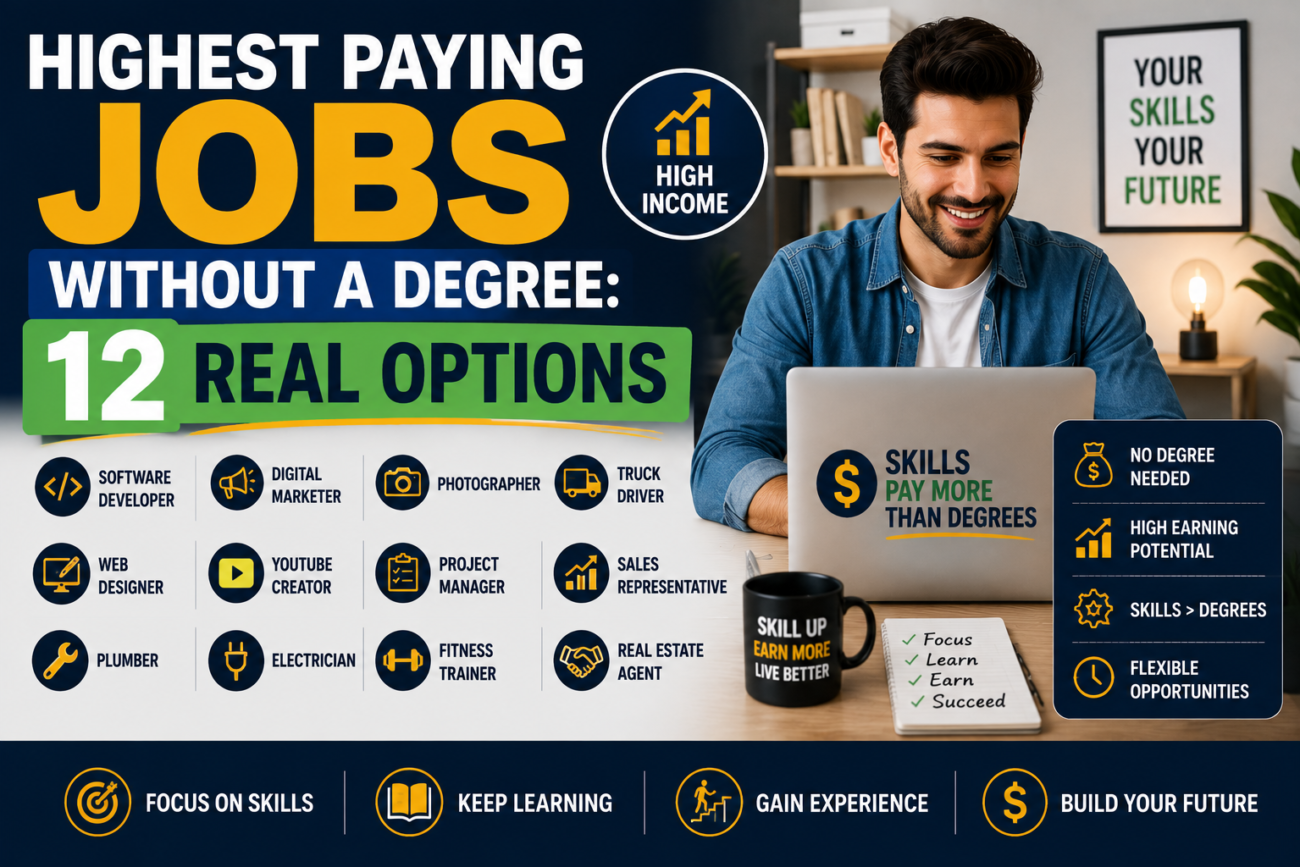
Highest Paying Jobs Without a Degree: 12 Real Options Worth Considering
Not having a degree doesn’t mean settling for low pay for the rest of your life, no matter how many job listings out there seem to insist otherwise. A four-year degree has become the default assumption for “good” careers, but it’s genuinely not the only path anymore, and it hasn’t been for a while. Plenty of people are earning solid, sometimes surprisingly high, incomes through skills that were never taught in a lecture hall.
If you’re looking into the highest paying jobs without a degree, the honest answer is that most of them require something else instead: a certification, an apprenticeship, a portfolio, or just enough hands-on practice to prove you can actually do the work. That’s a real trade-off, but for a lot of people searching for the highest paying jobs without a degree, it’s a faster and cheaper path than four years and a pile of student debt.

Why Skipping the Degree Doesn’t Mean Skipping the Skill
Before getting into specific roles, it’s worth clearing up a common misunderstanding. “No degree required” doesn’t mean “no effort required.” Most of the highest paying jobs without a degree still demand real skill-building, whether that’s through a trade school, an online certification, self-teaching, or years of on-the-job learning. The difference is where that learning happens and how much it costs, not whether it happens at all.
1. Software Developer
This might be the most well-known example of a high-paying, degree-optional career, and for good reason. Plenty of self-taught developers and coding bootcamp graduates land solid roles once they have a portfolio of real projects to show. Companies care far more about whether you can actually build something functional than which university you attended.
Free and low-cost resources like freeCodeCamp, The Odin Project, and various YouTube-based courses have made this path more accessible than ever, though it does take real, consistent time to get job-ready.
2. Electrician
Skilled trades consistently show up near the top of any honest list of the highest paying jobs without a degree, and electricians in particular tend to earn well once licensed. The path usually involves a paid apprenticeship, meaning you’re earning money while you learn instead of paying tuition, which flips the usual education cost equation on its head.
Demand for licensed electricians also tends to stay steady regardless of the broader economy, since electrical work isn’t something that can be outsourced or automated easily.
3. Real Estate Agent
Getting licensed usually takes a matter of months, not years, and the income potential scales almost entirely with effort and local market conditions rather than formal education. It’s commission-based, which means it’s not a guaranteed paycheck, but experienced agents in active markets can earn well above what many degree-required office jobs pay.
4. Plumber
Similar story to electricians. Licensed plumbers go through an apprenticeship model, earn while training, and end up in a trade that’s genuinely difficult to outsource or replace with software. Once licensed and experienced, especially with specialized commercial work, income potential is significant.
5. Web Developer or Designer
Slightly different from software development, this leans more toward building and designing websites for businesses rather than complex applications. It’s another skill that can realistically be self-taught through free resources, and a strong portfolio often matters more to clients than any credential.
Freelancing in this space also means you can start small, build a client base, and scale your rates as your portfolio grows, all without a single tuition payment.
6. HVAC Technician
Heating, ventilation, and air conditioning work is another trade with strong, steady demand. Training typically happens through a technical program lasting months rather than years, often followed by an apprenticeship. Experienced HVAC techs, especially those who eventually run their own small operation, can earn a genuinely comfortable income.
7. Sales Representative (Especially B2B or Technical Sales)
Many companies hiring for sales roles, particularly in software or technical industries, care far more about your ability to close deals and communicate clearly than your educational background. Base salaries vary, but commission structures mean top performers in this field often out-earn people in degree-required roles by a wide margin.
8. Commercial Pilot
This one surprises people. While it requires significant training and certification hours, a traditional four-year degree isn’t strictly required by most airlines, especially regional carriers. The path is expensive and demanding in its own way, through flight schools and required flight hours, but it doesn’t route through a university system.
9. Construction Manager
Experience on job sites, paired with project management skills and sometimes a specific certification, can lead to construction management roles without a bachelor’s degree, particularly if you work your way up from a trade position. Managing budgets, timelines, and crews is a skill set built through experience as much as classroom learning.
10. Wind Turbine Technician
A newer entry on this kind of list, but a genuinely fast-growing one. Training typically takes place through a technical certificate program lasting under two years, and demand has grown significantly alongside renewable energy expansion. Pay tends to be strong relative to the relatively short training period involved.
11. Court Reporter
Court reporting requires specialized stenography training, usually through a certificate program rather than a degree, and the skill itself, typing at extremely high speeds with specialized equipment, is in consistent demand across legal and government settings.
12. Freelance Writer or Content Strategist
Similar to web development, this path rewards a strong portfolio over a diploma. Businesses need blog content, email campaigns, and website copy constantly, and many of the highest-earning freelance writers built their reputation through consistent client work rather than a journalism degree.
What These Careers Actually Have in Common
Looking across this whole list, a pattern shows up pretty clearly. Almost every one of these roles substitutes a degree with one of three things: a paid apprenticeship, a certification program, or a portfolio built through real project work. None of them are instant, and none of them are effortless, but all of them prove that the highest paying jobs without a degree are a real, achievable path to solid income without four years of tuition.
According to the U.S. Bureau of Labor Statistics, several skilled trade and technical occupations show median wages that compare favorably to many degree-required roles, particularly once experience and licensing are factored in.
Building the Resume That Gets You There
Whichever path you’re considering, the way you present your skills matters just as much as the skills themselves. If you’re early in one of these careers and don’t have a long work history yet, it’s worth working through how to write a resume with no experience so you know how to frame training, certifications, and hands-on projects in a way that actually lands with employers.
Final Thoughts
The highest paying jobs without a degree aren’t a shortcut, exactly, they’re just a different route to the same destination. Some take an apprenticeship, some take a certification, some take a portfolio built on nights and weekends. What they all have in common is that the barrier to entry is skill and proof of that skill, not a diploma sitting in a frame. If the traditional four-year path doesn’t fit your situation right now, this list is proof that it was never the only door available.
