
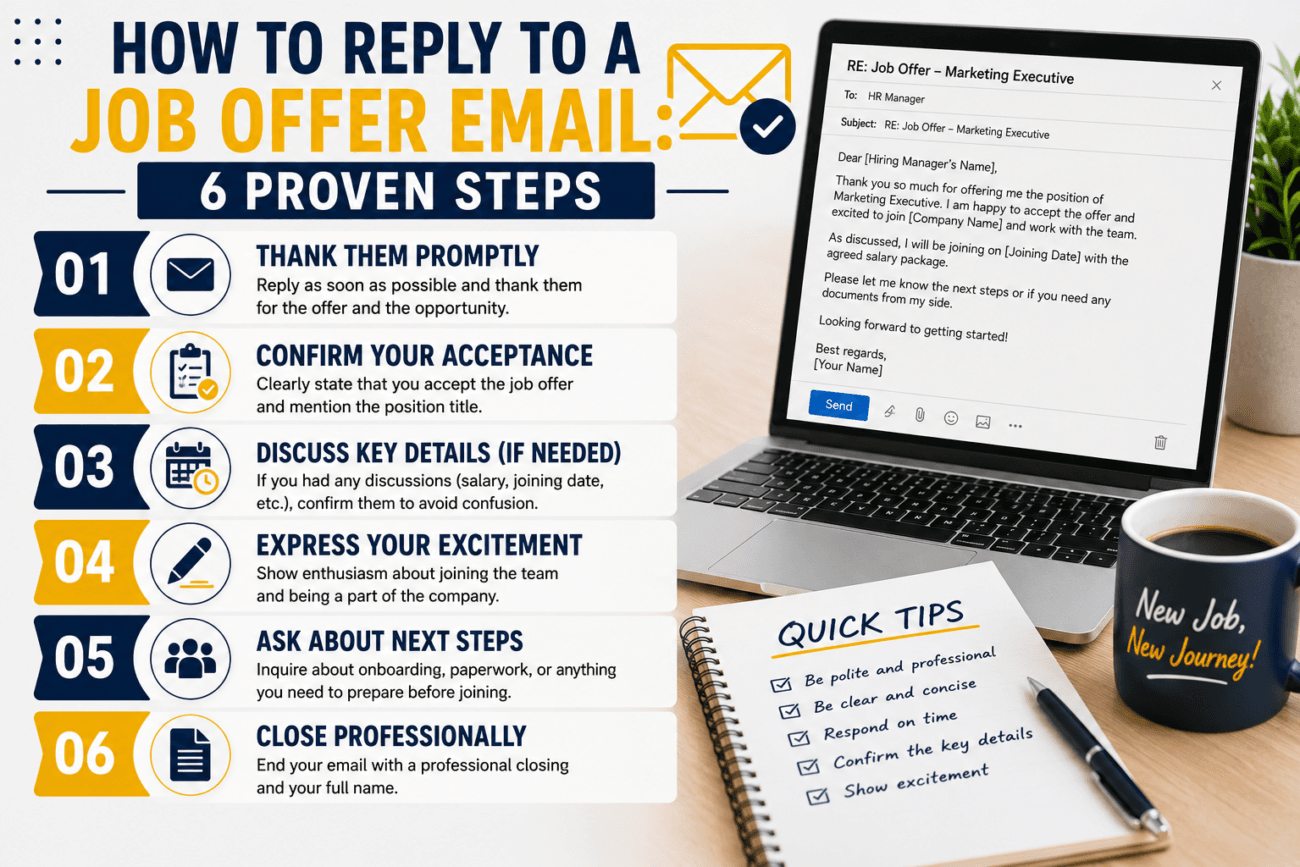
How to Reply to a Job Offer Email: 6 Proven Steps to Get It Right
I once sat staring at my laptop for almost twenty minutes, cursor blinking in an empty reply box, completely stuck. Not because I didn’t want the job I did, badly. I just had no idea how to reply to a job offer email without sounding either too desperate or too casual.
I typed “Thank you so much!!! I’m SO excited!!” and deleted it. Then I typed something so formal it sounded like a legal notice. Deleted that too. In the end I sent something in between, and it worked out fine, but I remember thinking — why does nobody teach you this part?
Turns out a lot of people freeze at this exact moment. You’ve done the hard part (interviews, waiting, more waiting), and now this one email feels oddly high-stakes. So let’s fix that.
If you’ve ever searched for how to reply to a job offer email at 11pm the night before a deadline, you already know exactly the feeling I’m talking about.
Why This Email Matters More Than You Think
Your reply isn’t just a formality. It’s often the first “real” written communication you’ll have as an almost-employee instead of a candidate. HR people remember how you sounded in this email I’ve heard this from two different HR managers I know personally.
A rushed, sloppy reply can make them wonder if you’re actually serious about the role. A reply that takes too long to arrive can make them nervous you’re weighing other offers (even if you’re not).
Knowing how to reply to a job offer email properly takes maybe ten extra minutes, and it sets the tone for your whole relationship with that company before you’ve even started.
The Three Situations You’ll Actually Face
Realistically, when people ask how to reply to a job offer email, they’re usually in one of three situations: accepting, declining, or asking for more time. Each needs a slightly different approach, so let’s go through them one by one.
It also helps to remember that companies aren’t expecting perfection here. HR teams read hundreds of these replies every year, and most of them just want clarity, not a masterpiece of business writing.
1. When You’re Accepting
This is the easy one, emotionally, but people still mess it up by either being too brief (“Sounds good, I accept”) or way too long, turning a simple email into an essay.
Here’s a simple structure that works:
- Thank them for the offer.
- Confirm you’re accepting say it clearly, don’t make them guess.
- Restate the key details (role, salary, start date) so both sides are on the same page.
- Ask about next steps (paperwork, documents needed, who to contact).
A real example I used:
Hi Sarah,
Thank you for the offer for the Marketing Coordinator role. I’m happy to accept, and I’m confirming the agreed start date of June 10th and the salary discussed of PKR 95,000/month.
Please let me know if there’s any paperwork or documents you need from my side before then.
Looking forward to joining the team.
Best, [Your Name]
Notice it’s short. Nobody at a company is expecting a paragraph about your feelings.
2. When You’re Declining
This one scares people because they feel like they’re burning a bridge. Honestly, if you decline politely, most companies respect it. I’ve turned down two offers in my career and both times got a friendly “no worries, good luck!” reply back.
Keep it simple:
- Thank them, genuinely.
- Decline clearly, without over-explaining.
- Optionally, leave the door open for the future.
Example:
Hi Ahmed,
Thank you so much for offering me the Content Writer position. After a lot of thought, I’ve decided to accept another opportunity that’s a closer fit for my current goals.
I really enjoyed talking with your team and hope our paths cross again down the line.
Best wishes, [Your Name]
You don’t need to explain exactly which other company or why. A short, respectful reason is enough.
3. When You Need More Time
This is the trickiest one, and honestly, the one I got wrong the first time. I once said “I need some time to think” without giving any timeframe, and the recruiter followed up two days later sounding mildly panicked because she assumed I was ghosting.
Lesson learned: always give a specific timeframe.
Hi Fatima,
Thank you for the offer — I’m genuinely excited about the possibility of joining. I’d like a couple of days to review everything carefully before giving my final answer. Would it be alright if I get back to you by Thursday?
Thanks again for your patience.
Best, [Your Name]
Most employers are fine with 2-3 days. Anything longer, and you should call them directly instead of just emailing.
Step-by-Step: Before You Even Start Typing
- Read the offer twice. Salary, benefits, start date, job title — make sure you actually understood it before responding.
- Check your tone out loud. Read your draft like you’re saying it to someone’s face. If it sounds robotic or overly stiff, rewrite it.
- Use a proper subject line. Something like “Re: Offer – Marketing Coordinator Role” works better than leaving the original subject untouched or, worse, blank.
- Send from a professional email, not the college-days one you made when you were fifteen. Yes, this still happens more than you’d think.
- Proofread once more. Grammarly’s free version catches most awkward phrasing if you’re not confident about your writing.
- Reply within 24-48 hours, even if it’s just to say you need more time.
Mistakes I’ve Seen (and Made)
Even once you know how to reply to a job offer email in theory, it’s easy to slip up in practice. Here are the mistakes I keep seeing, including a couple of my own.
- Replying with just “Ok, thanks” — technically a reply, but it reads as disinterested.
- Forgetting to restate the salary or start date, which sometimes leads to confusing mix-ups later.
- Sending the reply from a phone with autocorrect chaos still in it (I once sent “I accept the ffer” and had to send an awkward follow-up correction).
- Waiting too long to respond because the reply “felt scary,” which just made the whole thing more stressful than it needed to be.
- Copy-pasting a generic template word-for-word without adjusting the names and role details. Recruiters notice this instantly.
A Quick Reality Check
Your reply email won’t make or break the offer itself that part’s already settled. What it does is set the tone for how professional and prepared you look on day one, before you’ve even walked in the door.
Once you’ve replied to the offer and accepted it, keep an eye out for the appointment letter too, since that’s the document with the actual legal detail. If you’re not sure what separates the two, our guide on appointment letter vs offer letter breaks it down clearly.
Final Thoughts
The blinking cursor moment is normal. Almost everyone freezes a little before hitting send on something this important. But once you know how to reply to a job offer email whether you’re accepting, declining, or just asking for a few more days it stops feeling like a big deal and starts feeling like just another professional email.
Keep it short, keep it clear, and don’t overthink the wording as much as I did that first time. A polite, well-structured reply is really all it takes.
Source reference: For general professional communication etiquette, see Indeed’s career guide.
