
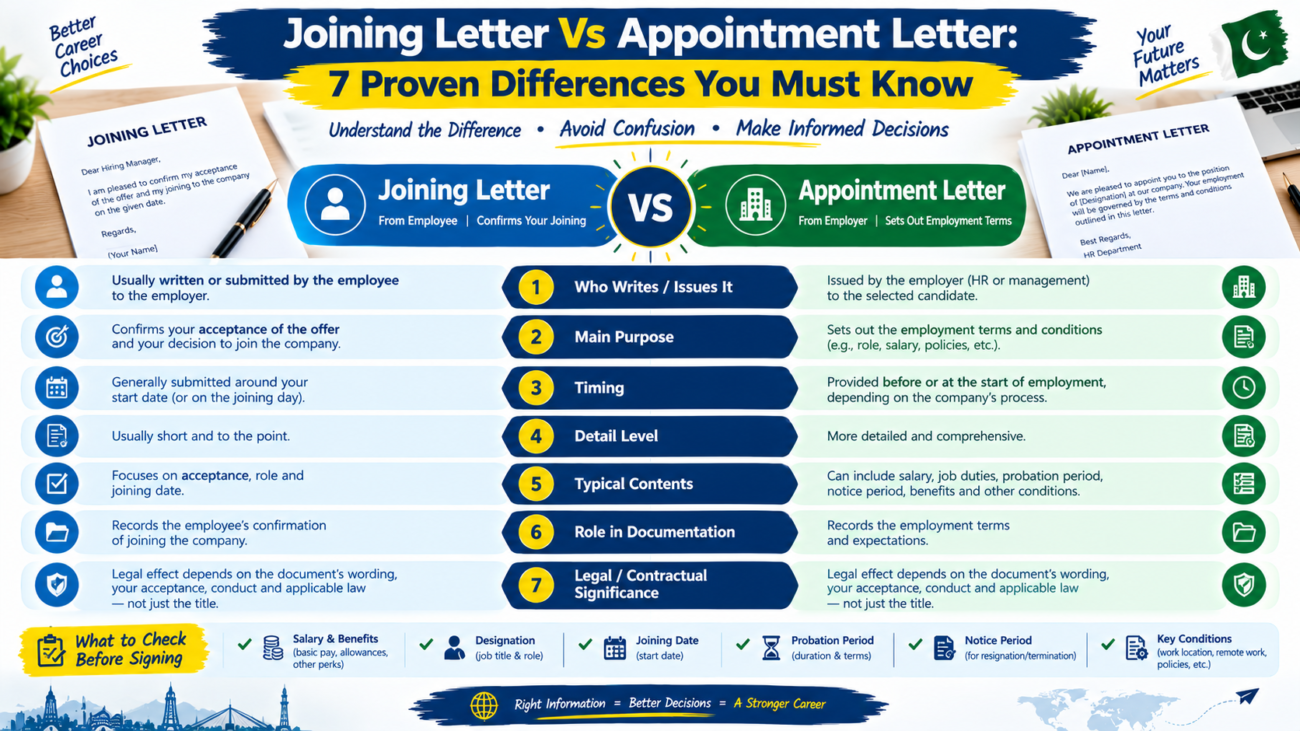
Joining Letter Vs Appointment Letter: 7 Proven Differences You Must Know
I still remember the confusion from my first “real” job. I had already signed my offer letter, packed my bag, told my whole family I was employed — and then HR sent me something called a “joining letter” a week before my start date. I panicked a little. Wasn’t I already appointed? Why was there another letter now? Was this a new condition? A trick?
Turns out, I wasn’t confused because I’m bad at reading documents. I was confused because almost nobody explains the difference between a joining letter and an appointment letter properly. Most companies just throw these terms around like they’re the same thing, and new employees are left guessing.
After going through this cycle a few times across different jobs — and helping a few friends decode their own HR emails — I finally understand exactly where each document fits. So let’s break down joining letter vs appointment letter the way I wish someone had explained it to me back then, instead of leaving me to figure out the joining letter vs appointment letter difference on my own.
What Actually Happens First
Before we get into definitions, here’s the real-life sequence, at least in most companies I’ve dealt with in Pakistan and the wider South Asian job market:
- You get an offer letter (this comes first, usually by email)
- You accept it
- You get an appointment letter once you’re formally hired
- Closer to your start date, you might get a joining letter or a joining formality email
That last step is the one people almost always forget exists — until it lands in their inbox and confuses them, exactly like it did to me.
Appointment Letter: The Formal “You’re Hired” Document
An appointment letter is the official document that confirms your employment. It usually includes:
- Your designation
- Your salary structure
- Your reporting manager
- Your start date
- Terms of probation (if any)
- Company policies you’re agreeing to
Think of it as the legal backbone of your employment. If there’s ever a dispute about your salary or role later, this is the document HR and you will both refer back to.
Joining Letter: The “Confirming You Actually Showed Up” Document
Here’s where the joining letter vs appointment letter confusion really starts. A joining letter isn’t about hiring you — it’s about confirming that you’ve physically joined the company on your first day.
In some companies, this is a formality email HR sends you to sign and return once you walk in. In others, it’s a letter you write yourself, addressed to HR, confirming you’re reporting for duty as agreed.
Yes — sometimes YOU are the one writing the joining letter, not the company. That single detail throws off a lot of first-time employees, including me the first time I encountered it.
The Core Difference, In Plain Words
If I had to explain joining letter vs appointment letter to a friend over chai, I’d say it like this:
- The appointment letter tells you that you ARE hired.
- The joining letter confirms that you HAVE joined.
One is about the decision. The other is about the action. That’s really the whole joining letter vs appointment letter puzzle, even though HR departments love to make it sound complicated.
A Mistake I Made (So You Don’t Have To)
At one job, I assumed my appointment letter was enough proof of employment for a bank loan application. The bank rejected it and specifically asked for a joining letter or proof of active employment instead, since the appointment letter only proved I was hired — not that I was currently working there.
That one mix-up cost me almost two weeks of back-and-forth with HR to get the right document reissued. Lesson learned: know which document proves what, before you actually need it for something official like a loan, visa, or lease.
When Each Document Actually Matters
Here’s where the practical side of joining letter vs appointment letter comes in — because each document serves a different real-world purpose:
Appointment letter is needed for:
- Visa applications
- Salary negotiation records
- Legal proof of your job terms
- Background verification by future employers
Joining letter is needed for:
- Confirming your current active employment status
- Bank loan or credit card applications
- Internal HR records (attendance, onboarding completion)
- Sometimes required by landlords for rent agreements
Step-By-Step: What To Do When You Receive Either
- Read it fully before signing anything. Don’t just skim past the salary and start date section.
- Check the designation and reporting structure match what was discussed verbally.
- Save a digital copy immediately — Google Drive or even just emailing it to yourself works fine.
- If it’s a joining letter you need to write yourself, keep it short: your name, position, date of joining, and a simple line confirming you’re reporting to work as agreed.
- Ask HR directly if you’re unsure which document you’re being asked for — there’s no shame in asking, trust me, everyone gets this mixed up at least once
Common Mistakes People Make
- Assuming the appointment letter alone is proof of current employment (it’s not, especially for banks).
- Losing track of the joining letter because it feels like “just a formality.”
- Not double-checking salary figures on the appointment letter against verbal offers.
- Signing a joining letter without actually confirming the start date is correct.
- Confusing a joining letter with an offer letter, which is a completely separate document sent even earlier in the process.
My Honest Take
Nobody sits you down on day one and explains joining letter vs appointment letter properly — you’re expected to just figure it out from context, and most people do, eventually, usually after one confusing moment like mine. If you’re currently staring at one of these documents wondering which one you’re holding, just remember: appointment is the decision, joining is the confirmation.
If you’re also sorting out other HR paperwork around this time, it’s worth reading up on Appointment Letter Vs Offer Letter as well, since that confusion usually hits right before this one does.
For a broader reference on standard employment documentation practices, SHRM’s overview of employment letters is a solid resource if you want the more formal HR perspective.
At the end of the day, these are just pieces of paper — but knowing what each one actually proves can save you a headache when a bank, landlord, or embassy suddenly asks for “proof of employment” and you’re not sure which letter to hand over.
