
Show Cause Notice Vs Warning Letter: What Each One Actually Asks of You
I got an email from HR with the subject line “Show Cause Notice – Response Required,” and my stomach dropped in a way that felt worse than any warning letter I’d gotten before. I assumed this was somehow more serious, maybe even the step right before losing my job. I spent that entire afternoon trying to figure out the show cause notice vs warning letter difference instead of actually focusing on my response, which, looking back, was exactly backwards.
Once I actually understood what I was holding, the anxiety made a lot more sense, but so did the fact that I was overreacting to the wrong part of it.
The Order These Usually Come In
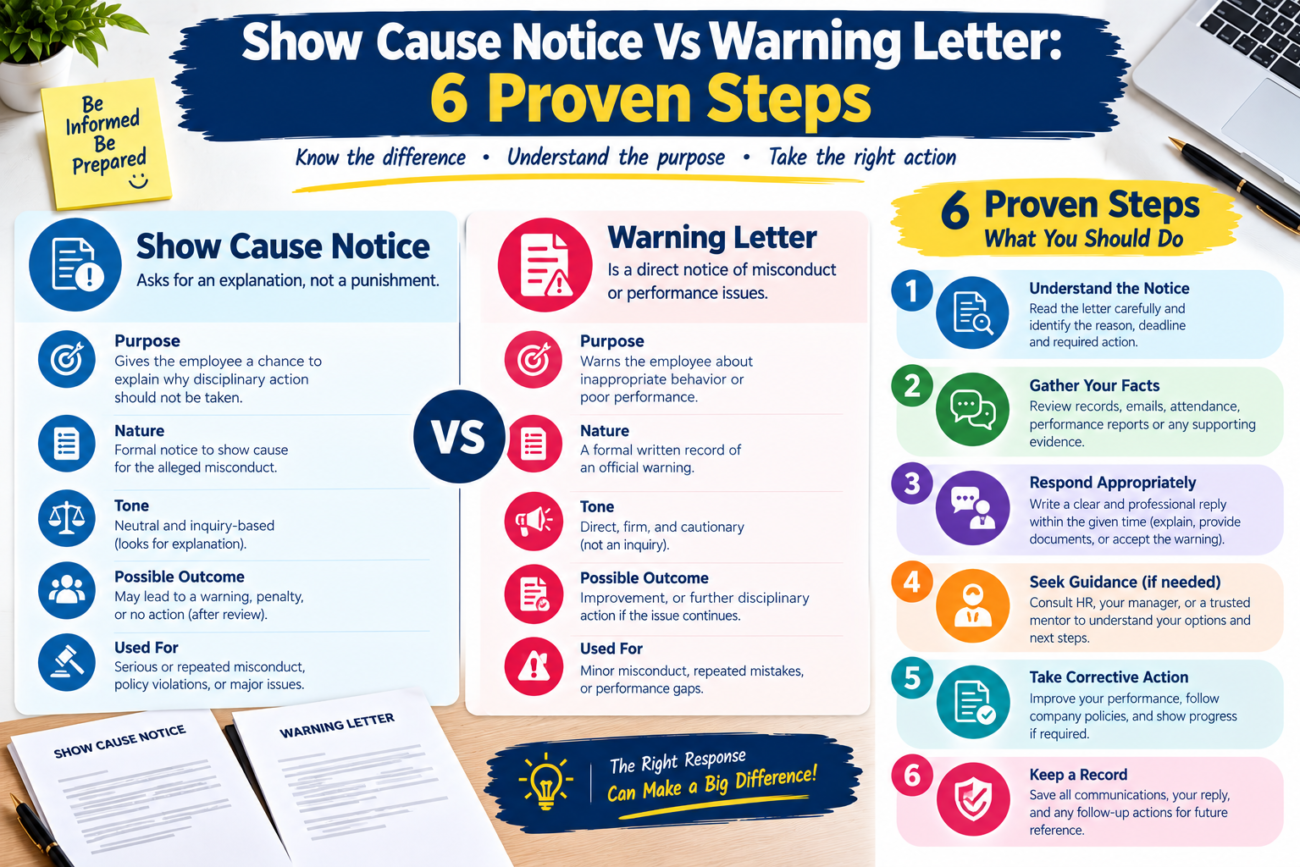
If you’re trying to make sense of show cause notice vs warning letter right now, the timing is actually the easiest way to separate them. Here’s what nobody explained to me clearly at the time: a show cause notice typically comes before a decision is made, not after. It’s your employer asking you to explain yourself before they decide what, if anything, to do about a situation. A warning letter, on the other hand, usually comes after that decision, once your employer has already concluded some form of action is warranted.
Think of it this way. The show cause notice is a question. The warning letter is an answer, specifically, the answer being “yes, we’re taking this seriously enough to formally note it.”
What Mine Actually Asked For
My show cause notice described a specific incident, missing a client call that I was supposed to lead, and asked me to submit a written explanation within 48 hours. It didn’t say I was in trouble yet. It said, essentially, “explain this, and we’ll decide next steps based on your explanation.”
I almost treated it like a formality and dashed off a quick two-line reply. A colleague who’d been through this before told me that was a mistake, and she was right.
Why Treating It Casually Is a Mistake
The show cause notice vs warning letter distinction matters most in exactly this moment: your response to a show cause notice can genuinely change the outcome. A warning letter, once issued, is usually final for that specific incident. But a show cause notice is still an open conversation, meaning your explanation has real influence over whether a warning letter follows at all.
I rewrote my response that evening, this time explaining the missed call properly. It turned out the client had rescheduled without confirming through the usual channel, and I had documentation showing I’d never received the updated meeting link. That context mattered, and it wasn’t in my original two-line reply.
Step-by-Step: How I’d Respond to One Now
1. Read it slowly, twice, before reacting emotionally. The tone of these notices is often more formal and serious-sounding than the actual situation warrants. Don’t let the formality alone convince you this is worse than it is.
2. Identify exactly what’s being asked. Mine asked for an explanation of one specific incident. It’s easy to start explaining your entire work history defensively instead of answering the actual question asked.
3. Gather any supporting evidence before writing your response. I nearly submitted my reply without checking my email for the original meeting invite. That single piece of evidence changed how the whole situation was received.
4. Keep your tone factual, not defensive or emotional. My first draft had a slightly frustrated tone about the client’s own scheduling mistake. I rewrote it to simply state the facts and let the documentation speak for itself.
5. Submit it within the given timeframe, and get confirmation it was received. Mine had a 48-hour window. I submitted it with about six hours to spare and asked HR to confirm receipt, mostly so there was no ambiguity later about whether I’d responded on time.
6. Ask what happens next, if it isn’t stated. Mine didn’t specify what would happen after my response was reviewed. I asked directly, and was told I’d hear back within a week either way.
What Happened After Mine
I didn’t receive a warning letter. HR reviewed my explanation, confirmed the scheduling mix-up with the client’s side, and the matter was closed with no further action. Looking back, if I’d sent my original rushed two-line reply instead of a properly documented explanation, I genuinely think the outcome could have gone differently.
When a Show Cause Notice Is More Serious
Not every one of these is a minor procedural question. A few signs I’d take more seriously:
- It references a specific policy violation rather than a single ambiguous incident
- It mentions a formal investigation already underway
- HR or a senior manager is directly involved, not just your immediate supervisor
- It explicitly states that failure to respond adequately may result in disciplinary action, including a warning letter or further steps
In these cases, it’s worth considering getting help drafting your response, whether that’s a mentor, a trusted colleague in HR, or in more serious situations, actual legal advice.
Common Mistakes People Make
I’ve seen the same show cause notice vs warning letter mistakes come up again and again, both in my own case and comparing notes with colleagues.
- Responding too casually because the notice arrives before any formal decision, mistaking it for a low-stakes formality.
- Not gathering evidence before writing a response, then having to follow up with additional context later.
- Writing an emotional or defensive response instead of a factual one.
- Missing the response deadline, which can itself be treated as a lack of cooperation.
- Assuming a show cause notice and a warning letter carry equal weight, when your response to the first can genuinely prevent the second.
How This Connects to What Comes Next
If your show cause notice does eventually lead to a warning letter, it helps to already understand what that document typically means and how seriously to take it. Our guide on warning letter vs termination letter walks through exactly that next stage, including the signs that indicate a warning is more serious than it might initially look.
Final Thoughts
Getting the show cause notice vs warning letter distinction straight in my head that afternoon would have saved me an entire anxious detour before I even started writing my actual response.
The show cause notice vs warning letter confusion cost me an entire anxious afternoon that would have been better spent actually building a proper response. A show cause notice is your chance to shape the outcome, not confirmation that the outcome has already been decided.
Take the explanation seriously, gather your evidence before you write anything, and respond factually within whatever window you’re given. It’s genuinely one of the few workplace documents where how you respond can change what happens next, rather than just documenting a decision that’s already been made.
For a broader look at how fair workplace investigation and disciplinary processes typically work, see SHRM’s overview of progressive discipline practices.
