
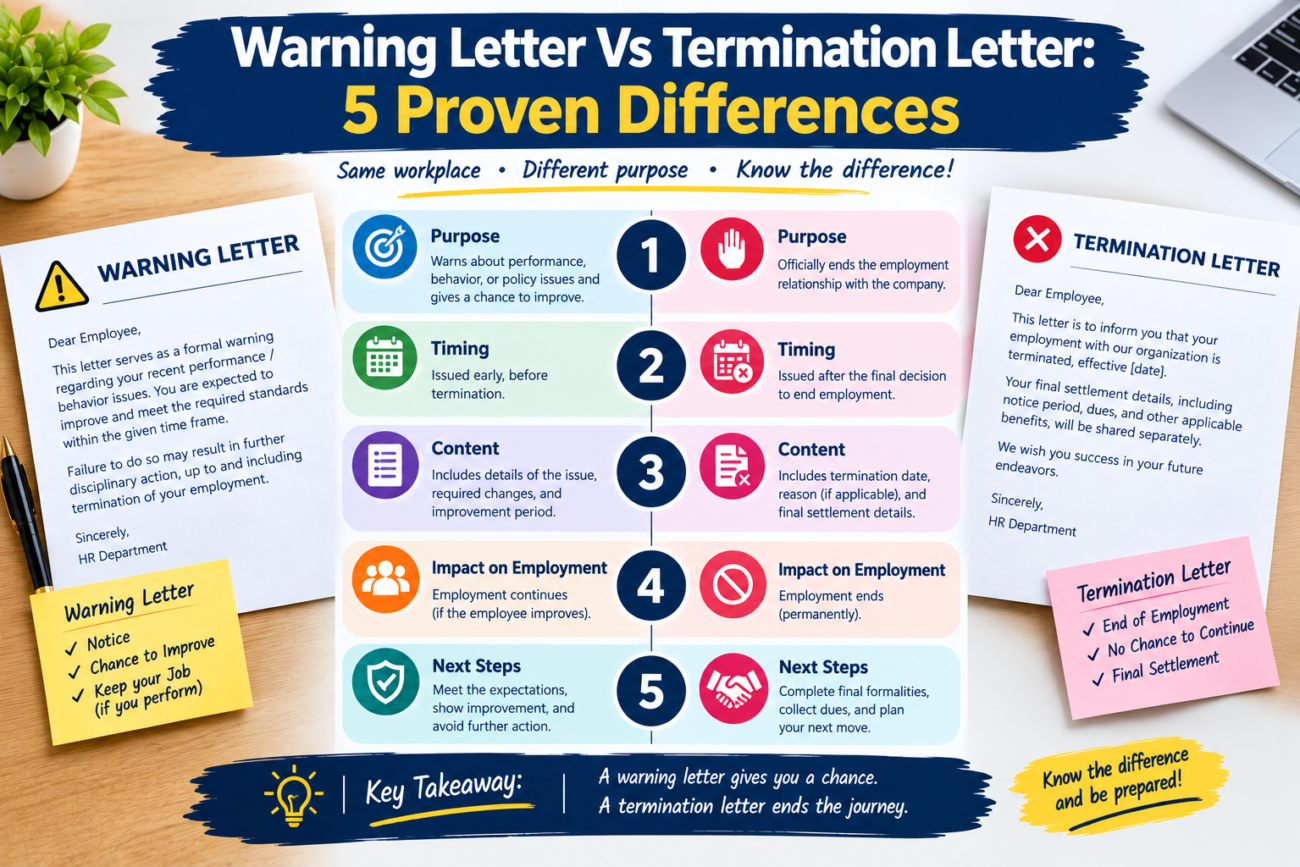
Warning Letter Vs Termination Letter: What Each One Actually Means for Your Job
I got my first warning letter over something that felt almost embarrassingly small, missing a project deadline by two days because a client kept changing requirements on me. I remember reading it at my desk, hands slightly shaking, absolutely convinced I was one step away from being fired. I spent that entire evening googling “warning letter vs termination letter” on my phone, trying to figure out how much trouble I was actually in.
Turns out, a lot less than I thought. But nobody had ever explained the actual difference to me before that moment, and the panic I felt was mostly built on not understanding what the letter in my hand actually meant.
If you’re holding one right now, or bracing for one, and searching warning letter vs termination letter trying to figure out how serious this actually is, I want to walk through what I eventually learned, both from that experience and from a couple of friends who went through similar situations with very different outcomes.
The Core Difference, Without the Legal Jargon
A warning letter is a correction. It’s your employer formally telling you something isn’t working, whether that’s performance, attendance, or conduct, and giving you a chance to fix it before things escalate.
A termination letter is an ending. It’s the document that actually ends your employment, and by the time you receive one, the decision has already been made.
The warning letter vs termination letter difference really comes down to this: one is a conversation still in progress. The other is the conversation being closed.
Why My Panic Wasn’t Entirely Irrational
I want to be honest here, because a lot of advice online brushes past this: a warning letter can eventually lead to termination if the issue isn’t addressed. It’s not always harmless. Companies often build a paper trail specifically so that if termination does happen later, they have documentation showing you were warned and given a chance to improve.
So the anxiety isn’t baseless, it’s just usually premature. Getting one warning letter, especially a first one, is rarely the final word. It’s a signal, not a verdict.
What My Warning Letter Actually Said (And What It Didn’t)
Looking back at it now, it had three parts: a description of the specific issue, a clear expectation of what needed to change, and a mention that continued issues “could result in further disciplinary action, up to and including termination.” That last phrase is standard, and it’s exactly the line that made me spiral, even though it’s boilerplate language in nearly every warning letter template.
What it didn’t have: any indication my job was actually at risk immediately, any timeline threatening dismissal, or any language suggesting this was final. Comparing it to a termination letter a friend later showed me, the difference was obvious in hindsight. Hers said, plainly, that her employment was ending on a specific date. Mine didn’t say anything close to that.
Step-by-Step: What I Did After Getting Mine
1. I read it twice before reacting. My first read was pure panic. My second read, an hour later, was when I actually absorbed what it specifically asked me to fix.
2. I asked my manager directly what improvement looked like. Vague warnings are hard to act on. I asked specifically, “what would need to change for you to consider this resolved,” and got a much clearer answer than the letter itself provided.
3. I documented my own side of the story. Since part of the issue was a client repeatedly changing requirements, I kept a written record of those changes going forward, timestamped emails, so if the same issue came up again, I had proof it wasn’t purely my performance.
4. I asked if this was a first warning or part of an existing pattern. This mattered more than I initially realized. A first warning and a second or third warning carry very different weight toward eventual termination.
5. I didn’t immediately start job hunting out of panic. I considered it, briefly. But acting purely out of fear before understanding the actual severity of the situation would have been a bigger mistake than the deadline miss itself.
When a Warning Letter Is More Serious Than It Looks
Not every warning letter is a minor bump. A few signs I’d genuinely pay closer attention to:
- It’s your second or third warning for the same issue
- It includes a specific timeline for improvement with a stated consequence date
- It mentions a formal performance improvement plan alongside it
- HR is copied on the communication, not just your direct manager
- The tone or language feels notably more formal than typical internal communication at your company
None of these guarantee termination is coming, but they shift the situation from “correct this and move on” to “take this seriously and document everything.”
What a Termination Letter Looks Like By Comparison
Once you’ve actually seen both side by side, the warning letter vs termination letter comparison stops being abstract. When my friend’s arrived, there was no ambiguity. It stated her last working day, referenced the prior warnings that led to the decision, outlined her final pay and benefits status, and included instructions for returning company property. There was no “improve or else” language, because the “or else” had already happened.
That’s really the clearest way to separate warning letter vs termination letter in the moment you’re holding one: a warning letter asks something of you going forward. A termination letter doesn’t, because there’s no “going forward” left with that employer.
Common Mistakes People Make
- Assuming a first warning letter automatically means termination is imminent, when it’s usually a chance to correct course.
- Not asking directly what specific improvement is expected, and guessing instead.
- Ignoring the letter entirely, assuming it’ll blow over without any visible effort to address it.
- Ignoring the difference between a first warning and repeated warnings for the same issue.
- Ignoring the letter emotionally instead of practically, spiraling instead of documenting and addressing the actual concern raised.
If You’re Currently Weighing Whether to Stay or Go
Sometimes a warning letter, even a fair one, is the moment you start genuinely questioning whether a role is still right for you, especially if the underlying issue feels outside your control. If that’s where your head is at, it’s worth working through our guide on signs you should quit your job, since a warning letter alone isn’t necessarily a reason to leave, but it can be a useful trigger to actually have that honest conversation with yourself.
Final Thoughts
The night I got my warning letter, I genuinely thought I was close to losing my job. I wasn’t. I fixed the specific issue, kept better documentation going forward, and never received another one during my time there.
Understanding warning letter vs termination letter isn’t just semantics, it changes how you should actually respond. One is a request to correct something. The other is a closed door. Read carefully, ask direct questions instead of assuming the worst, and treat the letter as information you can act on rather than a verdict you have to accept in silence.
For a broader look at how workplace disciplinary documentation typically works, see SHRM’s overview of progressive discipline practices.

One thought on “Warning Letter Vs Termination Letter: 5 Proven Differences”