
Experience Letter Vs Relieving Letter: 7 Proven Differences You Need Before Your Last Day
I resigned from my second job with exactly two weeks’ notice, feeling pretty proud of how professionally I handled the whole thing. On my last day, HR handed me an envelope and said “here’s your letter.” I said thanks, didn’t even open it properly, and moved on with my life.
Three months later, applying for a new role, the new company’s HR asked for my “relieving letter.” I sent them the envelope from before, feeling confident. Wrong document. What they’d given me was an experience letter. I didn’t even know there was a difference until that awkward email exchange.
If you’re staring down your notice period right now and someone just mentioned both these terms, you’re exactly where I was. Let’s clear up this experience letter vs relieving letter confusion before it costs you the same embarrassment it cost me.
Why Nobody Explains This Properly
Here’s the thing nobody tells you when you’re job hunting for the first time: leaving a company involves more paperwork than joining one. You’d think it’d be simpler, but companies want documentation on both ends.
The experience letter vs relieving letter mix-up happens because both documents get handed over around the same time, both come from HR, and both have “your name” and “the company name” printed at the top. From a glance, they look interchangeable. They are not.
The Actual Difference, In Plain Terms
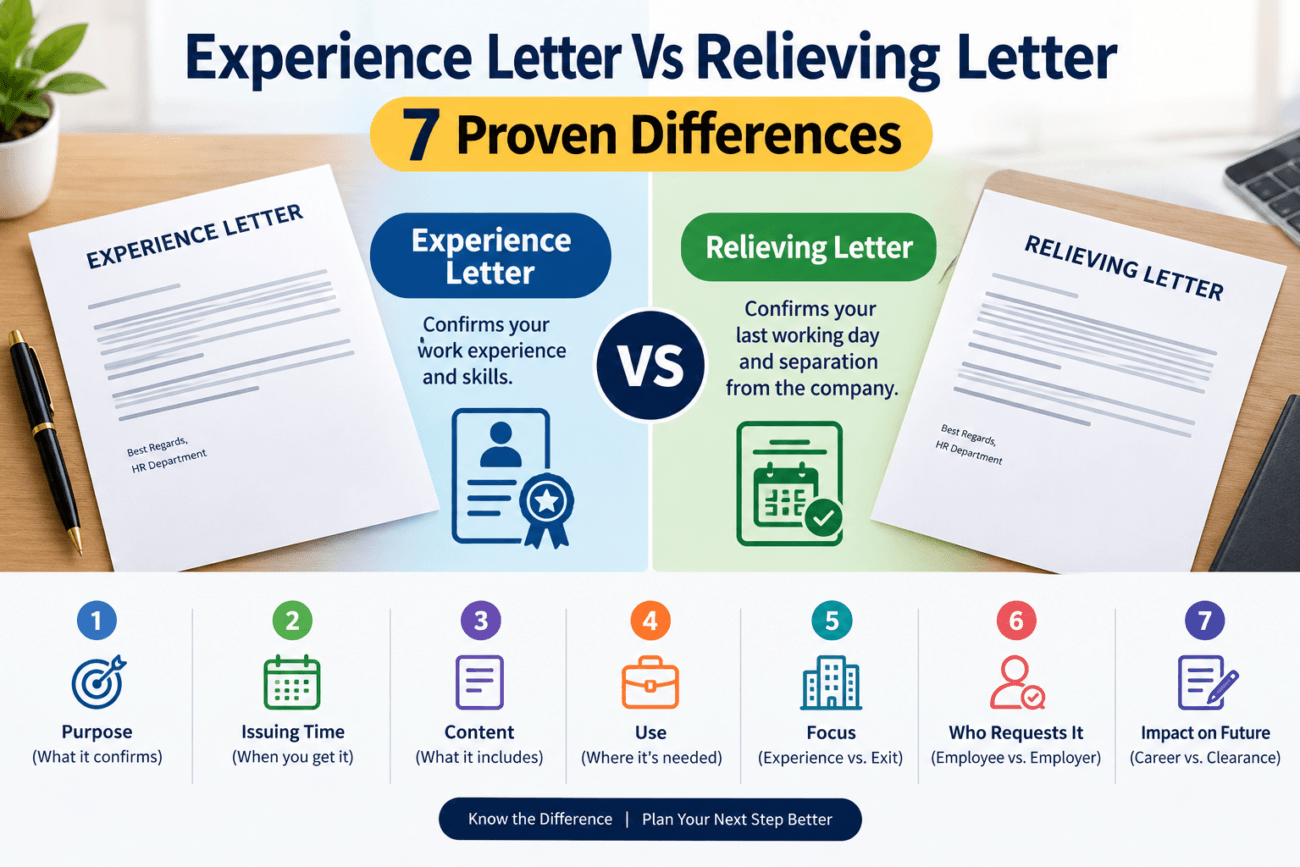
Once you sit with both documents side by side, the experience letter vs relieving letter question actually gets easy to answer. Think of it like this: the relieving letter is your exit receipt. It confirms you formally left, your dues are settled, and the company has no outstanding claim against you. The experience letter is more like a reference document — it talks about what you actually did there, your role, and how long you worked.
One closes a chapter. The other summarizes it.
7 Real Differences I Learned the Hard Way
I’ve now walked a couple of friends through this same experience letter vs relieving letter confusion, and the same seven points keep coming up every time.
1. What Each One Actually Proves
A relieving letter proves you left properly, with no pending obligations, no unfinished notice period, nothing hanging over your head. An experience letter proves you worked there, doing a specific job, for a specific length of time. My mistake was assuming one document could stand in for the other. It can’t.
2. When You Get Each One
The relieving letter almost always comes on your literal last working day, sometimes minutes before you walk out. The experience letter can come earlier, later, or even months after you’ve left if you request it separately. Nobody handed me a timeline for either, which is part of why I mixed them up.
3. Length and Detail
My relieving letter was maybe four lines. Name, designation, joining date, last working day, a line about “no dues pending.” My experience letter, when I eventually got the right one, was a full paragraph about my role, responsibilities, and even a line about “consistently meeting performance expectations.”
4. Who Actually Asks For Which
New employers doing background verification almost always want the relieving letter first, because it confirms you’re not still technically employed somewhere else. The experience letter comes up more when you’re building a resume, applying for a visa, or proving work history to a bank or embassy.
5. Can You Get It Without Asking
Relieving letters are usually automatic — HR processes them as part of your offboarding checklist. Experience letters, in a lot of companies, only get issued if you specifically request one. I’ve had friends who left jobs and never got an experience letter simply because they didn’t know to ask.
6. What Happens If You’re Missing One
Missing a relieving letter is the bigger problem. Some new employers will not proceed with onboarding without it, since it’s proof you’re not dual-employed. Missing an experience letter is annoying but usually fixable later with a polite email to your old HR department.
7. The Legal Weight Behind Each
A relieving letter has more formal weight since it closes an employment relationship on record. An experience letter is more of a goodwill document, an employer confirming your work history, without the same legal significance around termination.
A Mistake I Made (So You Don’t Repeat It)
I assumed both documents would just show up automatically on my last day. They didn’t. I got my relieving letter, no problem. My experience letter took an awkward follow-up email two weeks later, after my new HR contact specifically asked for it and I realized I didn’t actually have it.
Lesson learned: ask for both explicitly, in writing, before your last day. Don’t assume HR will hand you everything without a nudge, especially at smaller companies where offboarding isn’t as structured.
Step-by-Step: What To Do Before You Walk Out
- A week before your last day, email HR directly asking for both documents by name: your relieving letter and your experience letter. Don’t just say “my final documents.”
- Confirm your last working day matches what’s on both letters. I’ve seen mismatches where the resignation letter said one date and the relieving letter said another, which caused confusion during my friend’s background check.
- Check that your designation is spelled correctly on both. A small typo can trigger unnecessary questions from a new employer’s HR team.
- Get physical or signed digital copies, not just a verbal confirmation that “it’s been processed.”
- Scan and save both documents immediately somewhere you won’t lose them, cloud storage, email to yourself, wherever. You’ll need these again, sometimes years later.
Common Mistakes People Make
- Assuming the two documents are interchangeable, and sending the wrong one during background verification.
- Not requesting the experience letter at all, then scrambling for it months later.
- Losing the physical copy and having no digital backup.
- Not double-checking the last working day matches across both documents and your resignation letter.
- Waiting too long after leaving to request an experience letter, when the HR contact who processed your exit may have moved on themselves.
Which One Matters More?
Honestly, it depends on the moment. During background verification for a new job, the relieving letter usually gets asked for first and carries more weight. Later on, building your resume or applying somewhere that wants full work history, the experience letter becomes more useful.
If I had to boil down the whole experience letter vs relieving letter conversation into one sentence: the relieving letter proves you left cleanly, the experience letter proves what you actually did while you were there. You genuinely need both, just for different moments in your career.
Final Thoughts
Leaving a job feels like it should be the easy part after all the effort of actually doing the job. The paperwork side catches people off guard more often than it should, and this experience letter vs relieving letter mix-up is one of the most common paperwork mistakes I’ve seen, both in my own experience and from friends who’ve gone through the same thing.
Ask for both documents by name, confirm the details match, and keep your own copies before you hand back your laptop and badge. It’s a five-minute conversation with HR that saves you a much more annoying conversation with your next employer.
Before you get to this stage, it also helps to know what to expect earlier in the process — our guide on how to write a two weeks notice letter covers the step right before this one.
Source reference: For a broader look at standard employment documentation practices, see SHRM’s overview of offboarding procedures.

One thought on “Experience Letter Vs Relieving Letter: 7 Proven Differences”