
First Day at New Job Tips: What I Actually Did Wrong (So You Don’t Have To)
I showed up to my first day at a new job forty minutes early, sat in my car in the parking lot because I didn’t want to seem overeager, and then walked in exactly on time looking like I’d rushed. Meanwhile I forgot to eat breakfast because I was too nervous, and by 11am I was running on pure adrenaline and vending machine coffee. None of the first day at new job tips I’d read the night before mentioned that particular combination of mistakes, so here’s what I actually learned, including the parts that felt too small to matter until they did.
The Night Before Matters More Than People Admit
I used to think first-day prep started the morning of. It doesn’t. The night before, I laid out my clothes, which sounds basic, but past me had definitely once spent ten panicked minutes searching for a specific shirt at 7am. I also did a test run of my commute at the actual time I’d be driving it, since traffic patterns during actual rush hour looked nothing like the quiet Sunday afternoon I’d originally scouted the route on.
I also reread the offer email and any onboarding instructions one more time that night, just to catch anything I might have skimmed past the first time, like a specific entrance to use or a dress code detail I’d half-remembered wrong.
Show Up Early, But Not Weirdly Early
That sitting-in-the-parking-lot thing genuinely happened to me, and it’s more common than people admit. Arriving 15 minutes early is the sweet spot, early enough to show you’re organized, not so early that you’re awkwardly hovering in the lobby before anyone’s even expecting you. If you end up there way too soon like I did, grab a coffee nearby or just sit in your car for a few minutes rather than walking in 40 minutes ahead of schedule.
The Elevator Pitch You’ll Say More Times Than You Expect
Nobody warned me how many times I’d introduce myself on day one. By lunch, I’d said some version of “hi, I’m [name], I just started today, I’m working on [team]” probably a dozen times. Having that thirty-second version ready ahead of time meant I wasn’t fumbling through an awkward, rambling explanation every single time someone new walked up to my desk, and it’s honestly one of the simplest first day at new job tips that actually gets used the most. If you’ve already worked out how to answer tell me about yourself in an interview, you’re basically halfway to this version too, just trimmed down and less formal.
Step-by-Step: What Actually Helped Me Get Through the Day
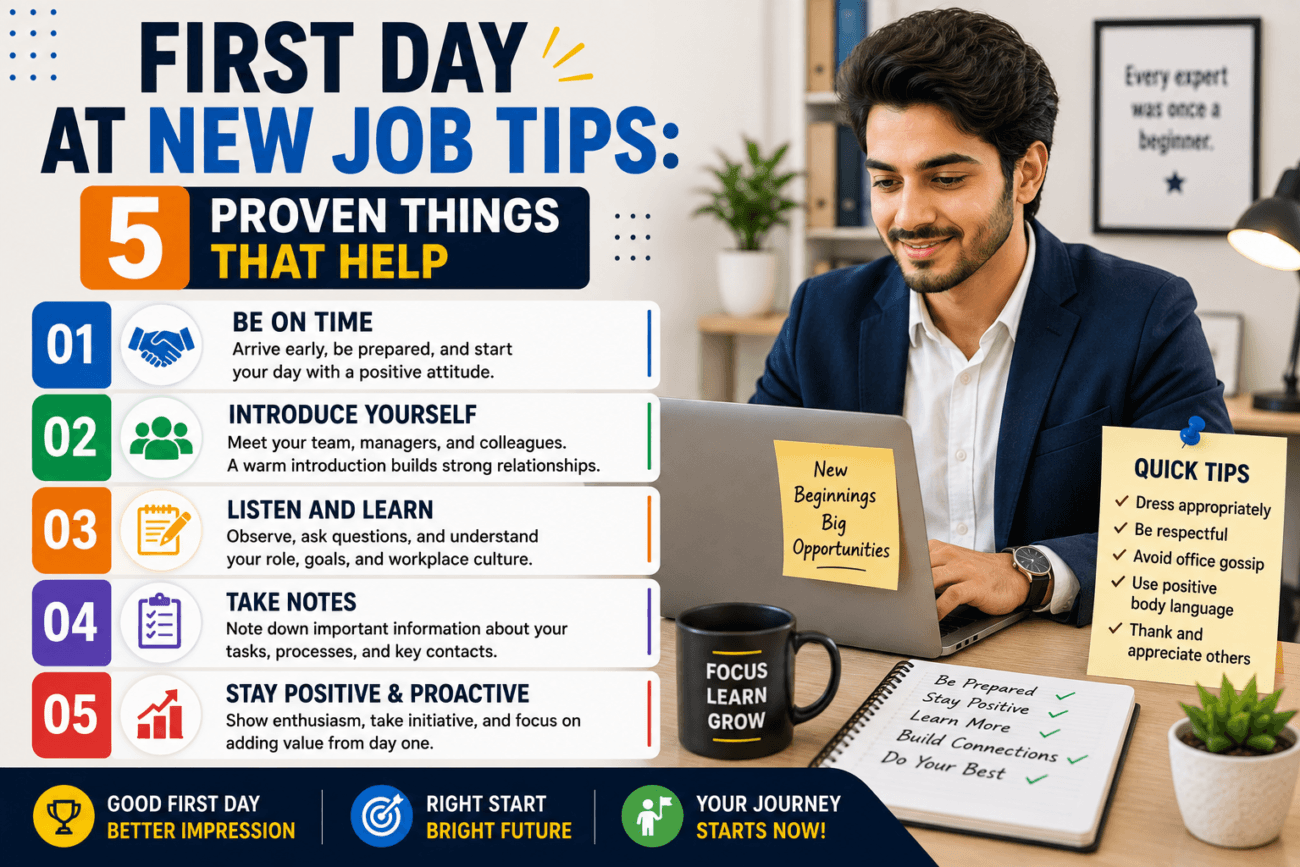
- Bring a notebook and actually use it. I underestimated how much information gets thrown at you on day one, names, systems, passwords, processes, and trying to remember all of it without writing anything down was genuinely impossible.
- Ask questions, but hold off on suggesting changes. I noticed a process on day one that seemed inefficient and almost said something about it out loud. A coworker later told me privately that jumping in with “at my old job we did it this way” on day one tends to land badly, even when the observation is fair. I learned to write those notes down and bring them up weeks later instead.
- Say yes to lunch invitations, even if you’d rather eat alone. I’m naturally introverted, and my instinct was to eat quietly at my desk. Forcing myself to join a group lunch that first week did more for actually settling in than almost anything else I did.
- Learn names deliberately, not passively. I started repeating a person’s name back when introduced, “nice to meet you, Sarah,” which sounds small but noticeably helped it stick better than just nodding along.
- Don’t try to prove yourself with output on day one. I felt pressure to immediately look productive and ended up half-listening during onboarding while trying to also seem busy. Nobody expects real output on day one. Listening and absorbing is the actual job that day, and it’s genuinely one of the most underrated first day at new job tips out there.
What I Wish Someone Had Told Me About Remote First Days
My second job’s first day was fully remote, and it came with its own specific stress. I tested my camera and internet connection the night before, which saved me from a scramble the next morning, but I hadn’t thought about lighting until I saw myself on the first video call looking like I was sitting in a cave. A cheap desk lamp facing me, angled slightly, fixed that in about two minutes once I noticed. I also made a point of sending a couple of short introductory messages to teammates before the day even started, which made the actual first video call feel less like meeting total strangers.
The Mistake That Actually Embarrassed Me a Little
Early in the day, someone asked what I’d done at my previous company, and I launched into a fairly detailed explanation of a process I thought was clever. I noticed partway through that I was subtly implying my old company did things better. Nobody said anything, but the energy in the room shifted slightly, and I caught myself and pivoted the story faster than I should’ve needed to. Since then, I keep first-day conversations focused on curiosity about the new place rather than comparisons to the old one, even when the comparison feels harmless in my head, which is one of the quieter first day at new job tips nobody says out loud.
A Realistic List of What to Actually Bring
- Government ID and any paperwork mentioned in your offer letter, direct deposit details if requested
- A notebook and pen, even if most notes end up digital afterward, having one physically ready avoids a scramble
- A light jacket or sweater, office temperatures are unpredictable and you don’t yet know your new building’s quirks
- A charged phone and laptop if remote, with chargers actually packed, not assumed to be near your desk
Why the First Week Matters More Than the First Day Alone
According to Robert Half’s research on new job transitions, the impressions formed in the first 30 days tend to shape how colleagues perceive a new hire long after that period ends, which means the pressure isn’t really about nailing day one perfectly, it’s about showing consistent curiosity and reliability across those first few weeks.
Final Thoughts
Looking back, most of my actual mistakes on day one were small, the parking lot hovering, the half-formed comparison to my old job, forgetting breakfast because I was too nervous to eat. None of them were disqualifying, and nobody remembered them the way I did in my head that night. The first day at new job tips that actually mattered most weren’t complicated, show up prepared, ask more than you assert, and give yourself permission to just observe instead of trying to prove something on day one. Those are really the first day at new job tips that stuck with me longest, and that part took me longer to learn than it probably needed to.

One thought on “First Day at New Job Tips: 5 Proven Things That Help”