
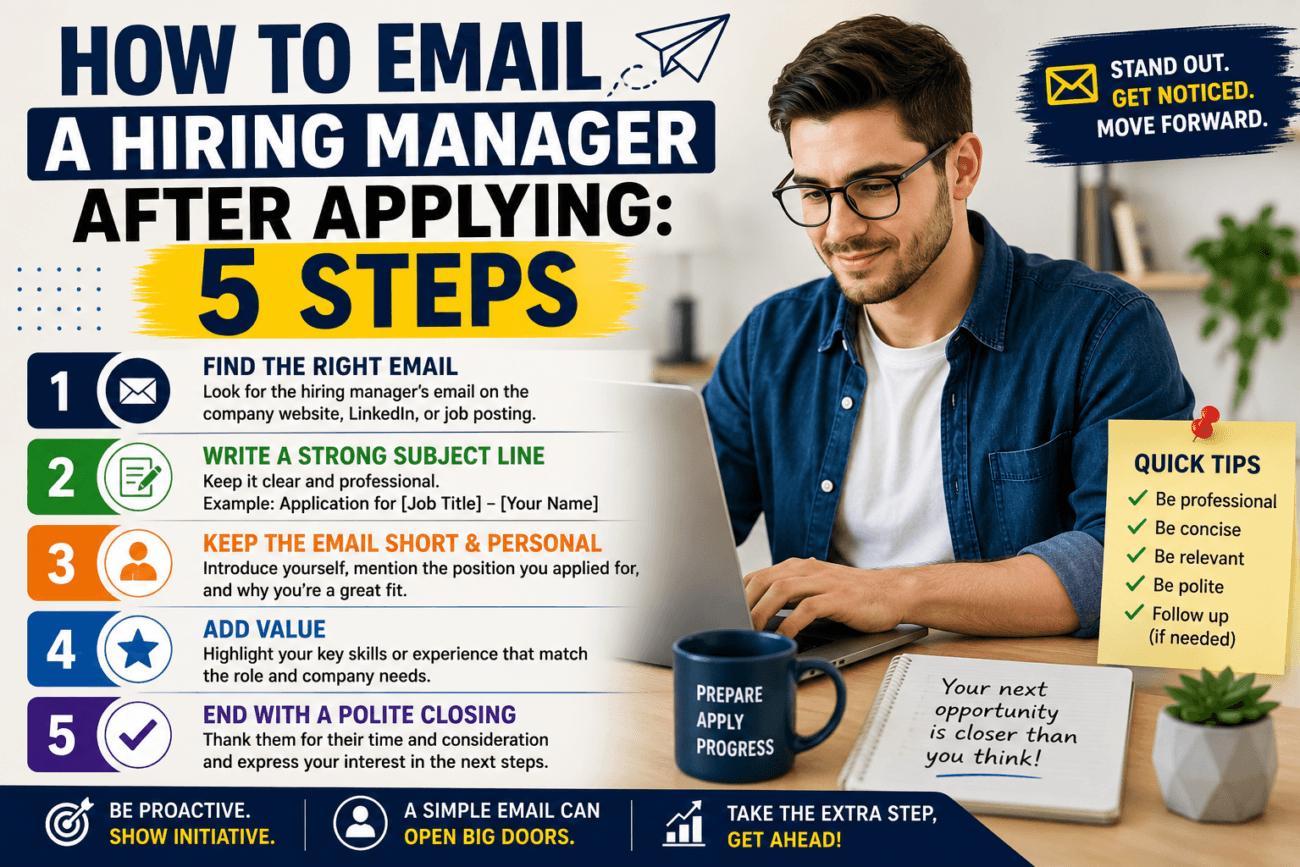
How to Email a Hiring Manager After Applying (Without Sounding Desperate)
I sat on a “should I actually do this” loop for two full days before sending my first cold email to a hiring manager. I’d applied through the company portal like everyone else, watched my application disappear into what felt like a black hole, and kept telling myself that reaching out directly would seem pushy or weird. Then a recruiter friend told me something that changed my mind completely: she said most candidates never do this, which is exactly why the ones who do stand out. Learning how to email a hiring manager after applying turned out to be one of those small moves that felt uncomfortable but paid off way more than I expected.
If you’re stuck in that same “is this too much” hesitation right now, here’s what actually worked once I got over it.
Why This Actually Works (Even Though It Feels Awkward)
Most applications go through an ATS, get scanned for keywords, and sit in a queue that a hiring manager might not personally review for days or weeks. A direct, well-written email skips that queue entirely and puts your name in front of an actual human. It’s not about jumping the line unfairly, it’s about making sure a real person actually sees your application exists, and that’s really the whole point of learning how to email a hiring manager after applying in the first place.
Step One: Find the Right Person, Not Just Any Email
My first attempt at this failed because I emailed a generic careers@ address I found on the company website, which basically goes to the same void the application already went into. What actually worked was searching the hiring manager’s name on LinkedIn, usually findable from the job posting itself or by searching “[Company] + [Department] manager.” Once I had a name, finding a likely email format took about two minutes using the company’s existing email pattern, which you can usually guess from a press release or an About page bio.
Step Two: Keep It Genuinely Short
This is the part I got wrong the first time. My first email was nearly 200 words, walking through my whole background like a mini cover letter. Nobody read past the second sentence, I’m fairly sure. The emails that actually got responses later were closer to 75 to 100 words total.
There’s real data behind this too, a recent industry benchmark found that emails between 50 and 125 words get roughly 50% higher reply rates than longer ones. Once I cut mine down that dramatically, responses started coming in within days instead of not at all, which taught me that how to email a hiring manager after applying really comes down to restraint more than persuasion.
Step Three: Structure It Like This
Here’s roughly what my better emails looked like, once I figured out the actual formula:
Subject: [Job Title] Application — Quick Note
“Hi [Name], I applied for the [Job Title] role earlier this week and wanted to follow up directly. I’ve spent the last three years doing [specific relevant work], and I was especially drawn to [something specific about the role or company, not generic]. Would you have 10 minutes sometime this week to talk about whether my background could be a fit? Happy to send over anything else that’s useful. Thanks, [Your Name]”
Under 90 words. One specific detail about the company, one clear ask, no lengthy re-explanation of my entire resume, that’s really the whole template for how to email a hiring manager after applying.
Step Four: Time It Right
I used to send these the same day I applied, which in hindsight was too eager, the application probably hadn’t even been logged into their system yet. Waiting three to five business days after applying gives the application time to actually register, while still being recent enough that the hiring manager can connect the dots when your name shows up in their inbox.
What I Left Out On Purpose
A few things I stopped doing after my first awkward attempt:
- Attaching my resume unprompted in the first email, it can come across as presumptuous before they’ve even responded, I offer to send it instead
- Using guilt-based language like “I know you’re probably busy, but…” which just adds unnecessary apologetic weight to a simple, reasonable ask
- Multiple exclamation points or overly enthusiastic language that reads as try-hard rather than genuinely interested
- Following up more than twice if there’s no response at all, at that point it’s genuinely time to move on
The Mistake That Almost Got Me Ignored Permanently
Early on, I sent a second follow-up just two days after the first one, getting impatient. That’s too soon, and it came across exactly how it sounds, impatient rather than professional. I waited a full week for follow-ups after that, and the tone landed noticeably better.
A Slightly Different Version When You Have No Named Contact
If you genuinely can’t find a specific hiring manager’s name, a short LinkedIn connection request with a note works as a reasonable substitute:
“Hi [First Name], I applied for the [Job Title] role at [Company] and wanted to connect. I’ve got [X years] in [field] and would love a quick chat if you’re the right person to speak with about this role.”
It’s less direct than an email, but it still puts a real name and face in front of someone instead of disappearing into an application queue entirely.
How This Connects to What Happens Later
If this email actually works and leads to an interview, the next thing you’ll need is a strong follow up email after interview, which uses a slightly different tone since you’ll have an actual conversation to reference by then. Together, these two touchpoints cover almost the entire communication gap most candidates leave completely empty during a job search.
According to the Data
A 2026 benchmark on hiring manager outreach recommends emailing within three to five business days of applying, with a short, four-to-five sentence structure that clearly states who you are, why you’re relevant, and what you’re asking for. That timing and structure lines up closely with what actually worked for me once I stopped overthinking how to email a hiring manager after applying and just started keeping it short.
Common Mistakes Worth Avoiding
- Emailing a generic careers@ inbox instead of finding an actual named contact
- Writing something closer to a full cover letter than a short note
- Sending it the same day you apply, before the application has even registered
- Following up too aggressively, more than twice with no response
- Forgetting to actually customize the one specific detail about the company or role
Final Thoughts
Figuring out how to email a hiring manager after applying was genuinely more about overcoming my own hesitation than learning some complicated skill. The actual email is short, specific, and low-pressure once you strip out all the second-guessing. It won’t work every time, plenty of my own attempts went unanswered too, but learning how to email a hiring manager after applying moved the needle often enough that skipping it entirely would’ve meant leaving real opportunities sitting in an ATS queue nobody was checking.
