
Medical Allowance Vs Health Insurance: What’s Actually on Your Payslip
My father needed a minor surgery a couple of years ago, nothing life-threatening, but the hospital bill still ran into six figures. I remember calling my own HR department in a bit of a panic, asking if my “medical” could cover it. The HR person asked me back, “Are you asking about your medical allowance or your health insurance plan?” I genuinely didn’t know those were two different things on my payslip. That one phone call is the whole reason I eventually sat down and figured out the medical allowance vs health insurance difference properly.
If you’ve ever looked at your salary breakdown and seen “medical” listed somewhere without really knowing what it covers, you’re not alone. Almost nobody explains this clearly when you join a company.
Why People Mix These Two Up So Easily
Both show up under something “medical” related on your payslip or in your offer letter. Both are meant to help with health-related costs. That overlap is exactly why the medical allowance vs health insurance confusion keeps happening, nobody sits you down and explains that one is cash, and the other is coverage.
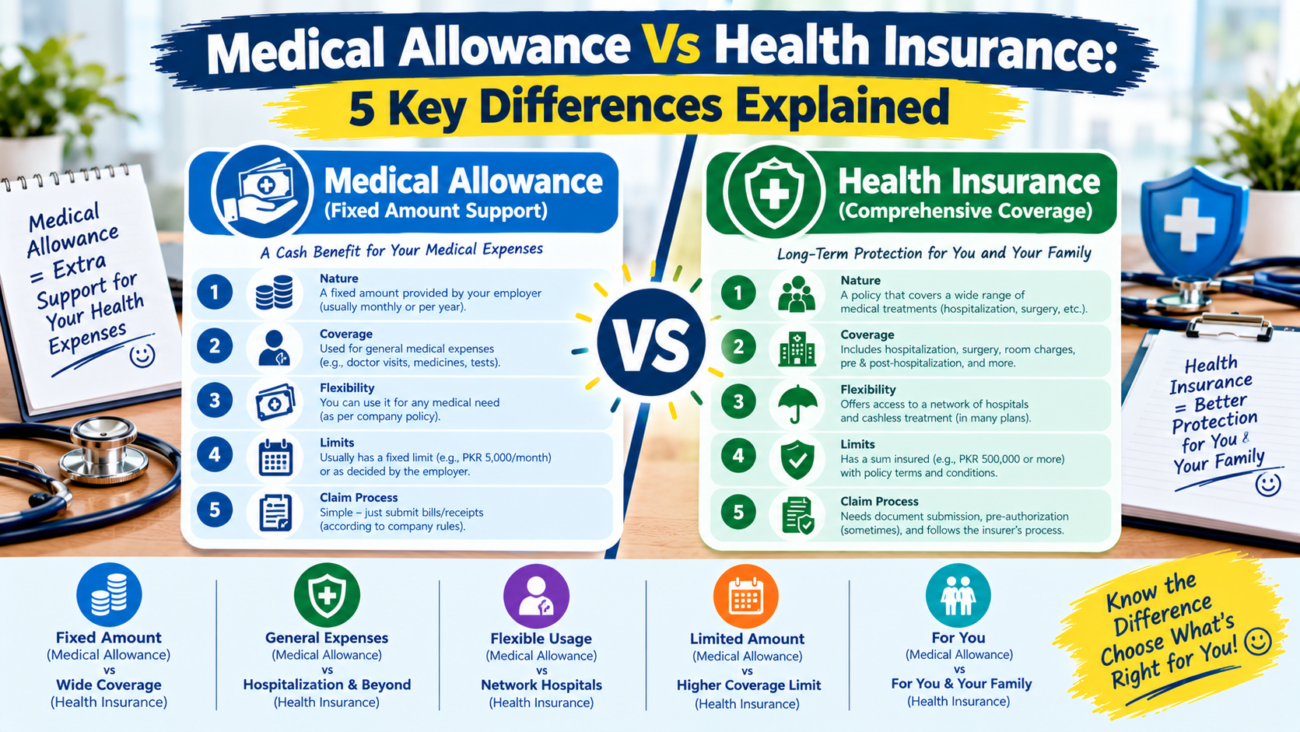
Here’s the short version before going deeper: medical allowance is money added to your salary every month. Health insurance is a separate policy that pays hospitals or reimburses bills when something bigger happens.
What Medical Allowance Actually Is
Medical allowance is a fixed amount your employer adds to your monthly salary, usually a flat figure or a percentage of your basic pay. It lands in your bank account along with the rest of your paycheck, no claims process, no paperwork, nothing to submit.
Here’s what surprised me when I actually checked my own payslip: this money isn’t tied to whether you actually spent anything on medical expenses that month. You get it whether you visited a doctor or not. It’s meant to cover small, routine costs, a pharmacy run, a basic checkup, over-the-counter medicine, not a hospital stay.
I used to assume this allowance would somehow “add up” into something big enough for a real emergency. It doesn’t work that way. It’s a small, steady cushion, not a safety net for anything serious.
What Health Insurance Actually Is
Health insurance is completely different. It’s a policy, either arranged by your employer (group health insurance) or one you buy yourself, that covers actual medical treatment, hospitalization, surgeries, sometimes outpatient visits, depending on the plan.
Unlike medical allowance, you don’t just receive this as cash. You either get a card to show at partner hospitals, or you submit bills afterward for reimbursement, depending on how your specific plan works. When my father’s surgery happened, it was the health insurance policy through his employer that actually covered most of the bill, not any monthly allowance sitting in his salary.
Not every company offers this. Some only give medical allowance and nothing else, which is exactly the kind of gap that catches people off guard during an actual medical emergency.
The Core Difference, in One Line
If it’s a fixed amount added to your salary every month regardless of whether you got sick, that’s medical allowance. If it’s a policy that actually pays or reimburses real medical bills when something happens, that’s health insurance. That’s the entire medical allowance vs health insurance distinction boiled down.
A Mistake I Made Before That Phone Call
For years, I genuinely assumed my medical allowance was some kind of informal insurance, that if something serious happened, that money would somehow cover it. It never occurred to me to check whether my company even offered actual health insurance separately.
When I finally asked HR directly, “Do we have group health insurance, or just the medical allowance in our salary?”, I found out my company did offer a basic health insurance plan, but I’d never registered my dependents under it because nobody told me I needed to actively do that during onboarding.
How to Actually Check What You Have
Once the medical allowance vs health insurance basics click, figuring out what you personally have gets a lot easier. Here’s the approach that worked for me:
- Check your payslip for a “medical allowance” line. It’ll usually show as a fixed amount, roughly the same figure every month, added to your gross salary.
- Ask HR directly whether the company offers group health insurance separately. A simple question works: “Besides the medical allowance in my salary, do we have a health insurance policy, and am I enrolled?”
- Confirm whether your dependents are covered. Some group health insurance plans only cover the employee by default, spouse and children sometimes need to be added separately during a specific enrollment window.
- Ask for your insurance card or policy details in writing. If a health insurance plan exists, get the actual card or policy number, don’t rely on a verbal “yes, you’re covered.”
- Find out which hospitals are in-network. A policy only helps quickly if you know, ahead of time, which hospitals will accept it directly instead of requiring you to pay first and claim reimbursement later.
A Real Example That Made This Click
A coworker of mine assumed her medical allowance would be enough when her child needed a few days of hospitalization. It covered almost nothing, the bill was many times larger than a few months of that allowance combined. She later found out her company did offer health insurance, but she’d never submitted the dependent enrollment form when she joined, so her child wasn’t actually covered. A completely avoidable gap, caught only after an expensive lesson.
Common Mistakes to Avoid
A few patterns I’ve noticed, in myself and in coworkers, around the medical allowance vs health insurance topic:
- Assuming medical allowance is some informal version of insurance that will scale up for emergencies
- Never asking HR whether the company offers group health insurance separately from the allowance
- Forgetting to enroll dependents during the specific window most companies require
- Not knowing which hospitals are in-network before an emergency actually happens
- Treating the monthly allowance as untouched “savings” instead of spending it on the small routine costs it’s actually meant for
If You’re Also Figuring Out Other Salary Deductions
If you’re trying to understand everything coming out of, or added to, your salary, it’s worth reading through EOBI vs provident fund as well, since retirement-related benefits get confused in a similar way to medical ones.
According to guidance from Pakistan’s Securities and Exchange Commission on proposed mandatory health coverage, health insurance in Pakistan is still largely employer-optional rather than legally required, so it’s worth confirming directly with your own company rather than assuming every employer provides it.
Final Thoughts
Once you actually sit down and compare them, the medical allowance vs health insurance confusion stops being confusing at all. One is a small, steady amount added to your salary for routine costs. The other is actual coverage for the expensive, unpredictable stuff, hospitalization, surgery, emergencies, and it only works if you’ve actually confirmed it exists and enrolled your dependents properly.
Next time you look at your payslip or offer letter, you’ll actually know what each line means, and more importantly, what questions to ask HR before you’re the one making a panicked phone call during an actual emergency.
