
EOBI Vs Social Security: What’s Actually Being Deducted From Your Salary
I needed a medical checkup a while back, nothing serious, just a persistent cough that wouldn’t go away. A coworker mentioned I could get it covered through “social security” since it was deducted from our salaries. I genuinely thought she meant EOBI, since that was the only deduction I actually recognized on my payslip. Turned out I had both, and I’d been paying for a medical benefit I never once used because I didn’t know it existed. That’s when I actually sat down and figured out the EOBI vs social security difference properly.
If your payslip has both of these line items and you’ve never really understood what each one does for you, you’re definitely not alone. Almost nobody explains this clearly when you join a company.
Why This Confusion Happens So Often
Both EOBI and social security are government-run, both get deducted from your paycheck alongside employer contributions, and both fall under the general umbrella of “employee benefits” that HR mentions briefly during onboarding and never explains again. That overlap is exactly why the EOBI vs social security mix-up is so common.
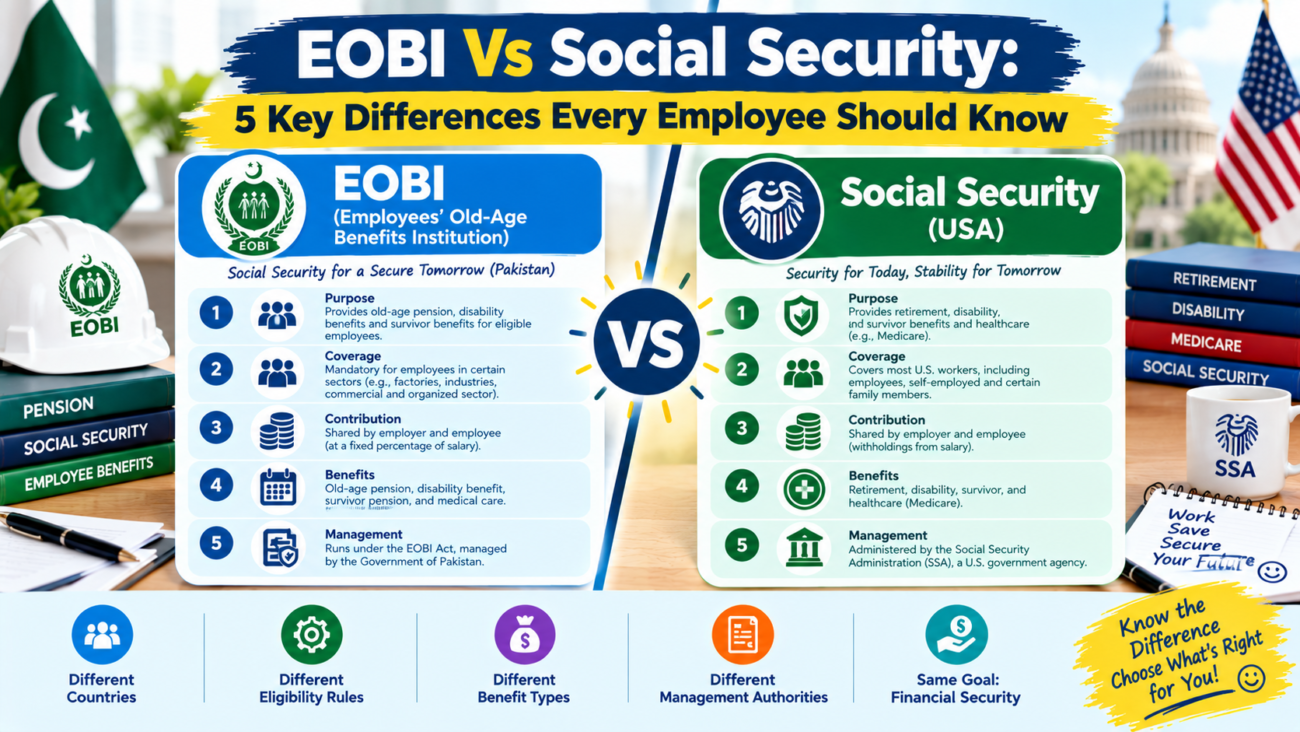
Here’s the short version before going deeper: EOBI is about retirement and old age. Social security, in the Pakistani context, is mostly about healthcare while you’re still working.
What EOBI Actually Covers
EOBI stands for Employees’ Old-Age Benefits Institution. It’s a federal pension scheme, and its entire purpose is long-term, it’s building toward a monthly pension you’ll receive after you retire, provided you’ve contributed for the required minimum number of years.
What surprised me most when I actually looked into this: EOBI contributions are calculated off the minimum wage, not your actual salary. So whether you’re earning close to minimum wage or several times that, your EOBI contribution stays roughly the same fixed amount. I’d assumed it scaled with income, and it doesn’t.
Both employee and employer contribute, with the employer paying the larger share. The payout is a monthly pension starting at retirement age, not something you can access while you’re still actively working.
What Social Security Actually Covers
Social security in Pakistan works through provincial institutions, Punjab Employees Social Security Institution (PESSI) in Punjab, Sindh Employees Social Security Institution (SESSI) in Sindh, and similar bodies in other provinces. Unlike EOBI, this isn’t primarily about retirement, it’s about medical and health-related coverage while you’re currently employed.
This is the part I completely missed for over a year. Registered employees can access medical treatment, hospitalization, and sometimes maternity benefits through social security dispensaries and hospitals, often at little to no cost. I’d been eligible for free medical checkups the entire time and just never knew the system existed or how to use it.
Employer contributions fund most of this scheme, and the employee share, where it exists, is typically small.
The Core Difference, in One Line
If it pays out years from now as a monthly pension after you stop working, that’s EOBI. If it covers medical treatment right now while you’re employed, that’s social security. That’s the entire EOBI vs social security distinction boiled down to one sentence.
A Mistake I Made for Over a Year
I assumed, because both showed up as government-related deductions, that they were basically the same scheme with two names. They’re not, and not understanding this cost me actual money, I paid out of pocket for a doctor’s visit that I could have gotten covered, or at least significantly discounted, through social security.
When I finally asked HR directly, “Am I registered with provincial social security, and if so, where can I actually use it?”, I found out my company had registered me months earlier. I just never knew to ask.
How to Actually Check What You Have
Once the EOBI vs social security basics click, figuring out what you personally have access to gets a lot easier. Here’s the approach that worked for me:
- Check your payslip for both line items. EOBI usually shows as a small, consistent deduction. Social security, where it applies, often shows as a smaller or sometimes employer-only contribution.
- Ask HR directly which provincial social security body you’re registered with. PESSI, SESSI, or your province’s equivalent, since the name depends on where you’re employed.
- Request your registration number for both schemes. You’ll need your EOBI number separately from your social security registration number, they’re not interchangeable.
- Ask where you can actually use social security benefits. There are specific dispensaries and hospitals tied to the scheme, and most employees, myself included, have no idea where their nearest one is until they ask directly.
- Confirm whether dependents are covered too. Some social security schemes extend basic coverage to a spouse or children, which is worth knowing before you assume you’d have to pay out of pocket for a family member’s treatment.
A Real Example That Made This Click
A coworker’s wife needed a relatively routine but not cheap procedure, and he mentioned it casually in passing, assuming he’d be covering the full cost privately. Another colleague asked if he was registered with social security and whether his wife was listed as a dependent. He wasn’t sure, checked with HR, and it turned out she was covered and the procedure cost him a fraction of what he’d braced himself for. He’d been contributing to social security for three years without ever using it or realizing what it actually covered.
Common Mistakes to Avoid
A few patterns I’ve noticed, in myself and in coworkers, around the EOBI vs social security topic:
- Assuming EOBI and social security are the same scheme because both are government deductions
- Never asking HR which provincial social security institution you’re actually registered with
- Not knowing where the nearest social security dispensary or hospital is until a medical need comes up suddenly
- Paying out of pocket for care that social security might have partially or fully covered
- Forgetting to check whether dependents are covered, and assuming they automatically aren’t
If You’re Also Figuring Out Provident Fund
If you’re trying to get a full picture of everything coming out of your salary, it’s worth reading through EOBI vs provident fund as well, since provident fund is a completely separate, company-specific benefit that often gets mixed into the same confusion. Gratuity vs provident fund covers another related piece of the same puzzle.
According to guidance on Pakistan’s provincial social security institutions, coverage and contribution structures can vary by province, so it’s worth confirming the specifics with your own provincial body rather than assuming your situation matches a coworker’s in a different city.
Final Thoughts
Once you actually sit down and compare them, the EOBI vs social security confusion stops being confusing at all. One is a long-term pension tied to your retirement years. The other is a medical safety net you can potentially use right now, while you’re still working, and it’s genuinely worth knowing whether you’re registered and where to access it before you end up paying out of pocket for something that was already covered.
Next time you glance at your payslip and see both deductions, you’ll actually know what each one is doing for you, and more importantly, you’ll know which questions to ask HR to actually use the benefits you’re already paying into.
