
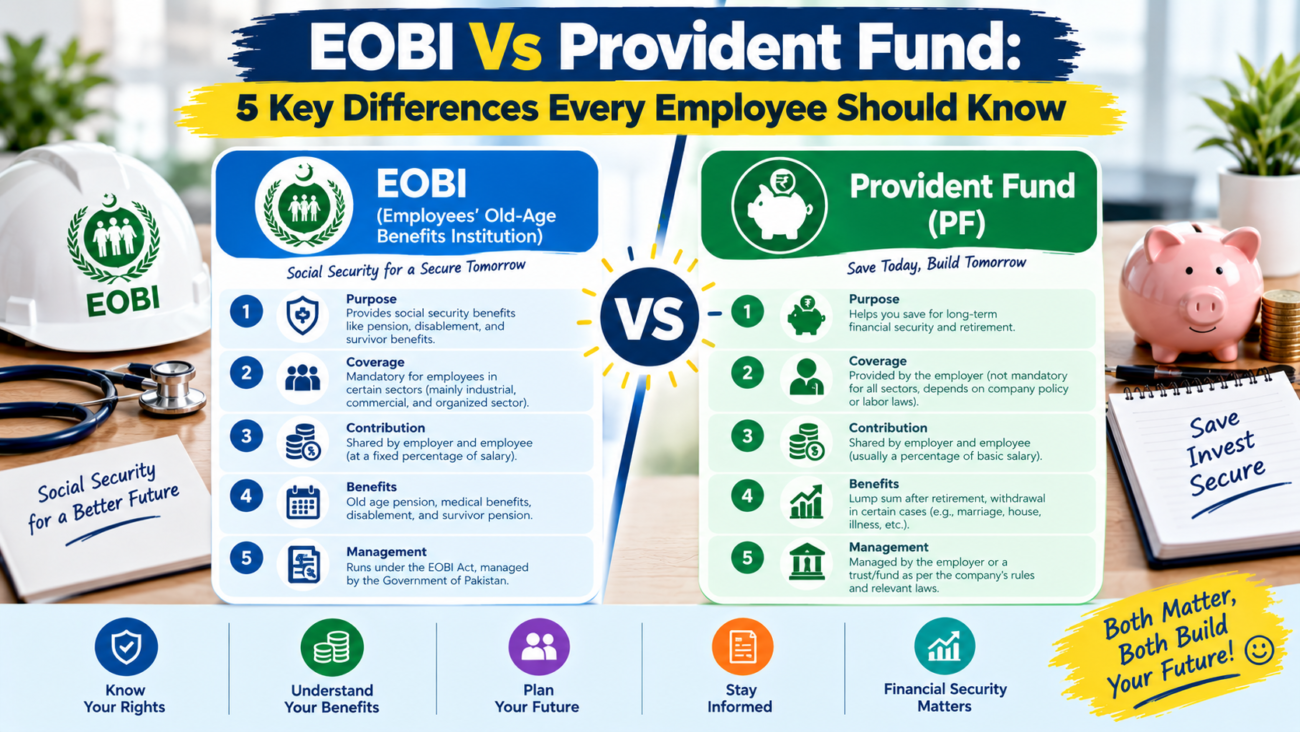
EOBI Vs Provident Fund: What’s Actually Being Deducted From Your Salary
My first payslip in Pakistan had a line item I’d never seen before: “EOBI Deduction.” I messaged a friend who’d been working longer than me and asked, “Isn’t this the same as the provident fund thing my offer letter mentioned?” He wasn’t sure either. Took me almost a year, and a slightly embarrassing conversation with HR, to actually understand the EOBI vs provident fund difference properly.
If your salary slip has both of these showing up and you’re not totally sure what each one actually does for you, you’re in good company. Almost nobody explains this clearly when you join a company, it just quietly shows up as a deduction and you’re expected to know what it means.
Why This Confusion Happens So Often
Both EOBI and provident fund are retirement-related, both come out of your paycheck (or your employer contributes on your behalf), and both are supposed to help you financially once you stop working. That overlap is exactly why the EOBI vs provident fund mix-up is so common, nobody sits new employees down and explains how the two actually differ.
Here’s the short version before we go deeper: EOBI is government-run and mandatory. Provident fund is usually employer-specific and often voluntary, depending on the company.
What EOBI Actually Is
EOBI stands for Employees’ Old-Age Benefits Institution. It’s a federal government pension scheme, meaning it exists regardless of which company you work for, as long as that company is registered and has five or more employees.
Here’s what surprised me when I actually looked into it: EOBI contributions aren’t based on your actual salary. They’re calculated as a percentage of the minimum wage, not what you’re actually earning. So whether you make the minimum wage or five times that, your EOBI contribution stays roughly the same. I genuinely assumed mine would scale with my salary, and it doesn’t.
Both you and your employer contribute. Your share is small, usually just 1% of the minimum wage, while your employer contributes more on top of that. The payout comes later, as a monthly pension after retirement, provided you’ve contributed for the required minimum number of years, typically around 15.
What Provident Fund Actually Is
Provident fund works completely differently. It’s not a government scheme, it’s something individual companies choose to set up, and the rules depend entirely on your specific employer’s policy.
Unlike EOBI, provident fund contributions are based on your actual salary, usually a percentage of your basic pay, and both you and your employer put money into it. Some companies match your contribution dollar for dollar, others use a different ratio. I’ve had a job where my employer matched 10% of my basic salary into the fund, and a previous one where there was no provident fund at all, just EOBI.
The payout for provident fund typically comes as a lump sum, either when you leave the company or at retirement, depending on the specific scheme’s rules. That lump sum can genuinely be a meaningful amount of money if you’ve stayed somewhere for several years.
The Core Difference, in One Line
If it’s calculated off the minimum wage and the government runs it, that’s EOBI. If it’s calculated off your actual salary and your specific employer set it up, that’s provident fund. That’s the entire EOBI vs provident fund distinction boiled down.
A Mistake I Made Early On
I assumed, for longer than I’d like to admit, that having EOBI deducted meant I automatically also had a provident fund, since both showed up as retirement-related terms in conversations with coworkers. They’re not the same thing, and not having one doesn’t mean you’re missing the other.
When I switched jobs the second time, I specifically asked HR during the offer stage: “Does this company offer a provident fund, or is it just EOBI?” Turned out the new company only did EOBI, no provident fund at all, which was a real factor I wish I’d known before comparing the offer to my old job’s total compensation.
How to Actually Check What You Have
Once the EOBI vs provident fund basics click, figuring out what you personally have gets a lot easier. Here’s the approach that’s worked for me since that first confusing payslip:
- Look at your payslip line items directly. EOBI usually shows as a small, consistent deduction regardless of your salary level. Provident fund, if it exists, usually scales with your basic pay.
- Ask HR directly during onboarding, not after you’ve already started wondering. A simple question works: “Can you confirm whether this role includes EOBI only, or EOBI plus a provident fund?”
- Check your offer letter or employment contract. Provident fund eligibility and contribution percentages are often spelled out there, EOBI usually isn’t mentioned since it’s a legal requirement rather than a company benefit.
- Ask about the employer match if provident fund exists. Some companies match your contribution fully, others partially. This meaningfully changes how much you’re actually accumulating.
- Request your EOBI registration number from HR. This is separate from your CNIC and lets you verify your contribution history directly with EOBI later on.
A Real Example That Made This Click for Me
A coworker of mine left a company after six years, and when he got his final settlement, the provident fund payout was a genuinely significant chunk of money, built up from years of both his and his employer’s contributions. Meanwhile, his EOBI contributions stayed with the government scheme entirely separately, something he won’t actually see until he reaches retirement age and claims a monthly pension. Two completely different pots of money, two completely different timelines for when he’d actually benefit from them.
Common Mistakes to Avoid
A few patterns I’ve noticed, in myself and in coworkers, around the EOBI vs provident fund topic:
- Assuming EOBI and provident fund are interchangeable terms for the same thing
- Not asking about provident fund availability before accepting a job offer, then being surprised later
- Forgetting to collect your EOBI registration number, which makes checking your contribution history harder down the line
- Assuming your EOBI contribution scales with your salary, when it’s actually tied to minimum wage regardless of what you earn
- Not understanding that provident fund rules differ company to company, so your friend’s provident fund terms might look nothing like yours
If You’re Comparing Job Offers
If you’re weighing two job offers and trying to figure out the real financial picture, it’s worth reading through gratuity vs provident fund as well, since gratuity is another retirement-related benefit that often gets mixed up with provident fund the same way EOBI does.
According to EOBI’s official contribution guidelines, contribution rates and eligibility rules are reviewed periodically, so it’s worth checking the current rate directly rather than relying on what a coworker tells you, since that number does shift over time.
Final Thoughts
Once you actually sit down and compare them, the EOBI vs provident fund confusion stops being confusing at all. One is a government pension tied to minimum wage that follows you regardless of employer, the other is a company-specific savings benefit tied to your actual salary that depends entirely on where you work. Knowing which one (or both) you actually have isn’t just trivia, it genuinely affects how you compare job offers and how you plan for retirement down the line.
Next time you see either term on a payslip or in an offer letter, you’ll actually know what you’re looking at, and more importantly, what questions to ask HR before you accept anything.

One thought on “EOBI Vs Provident Fund: 5 Key Differences Every Employee Should Know”