
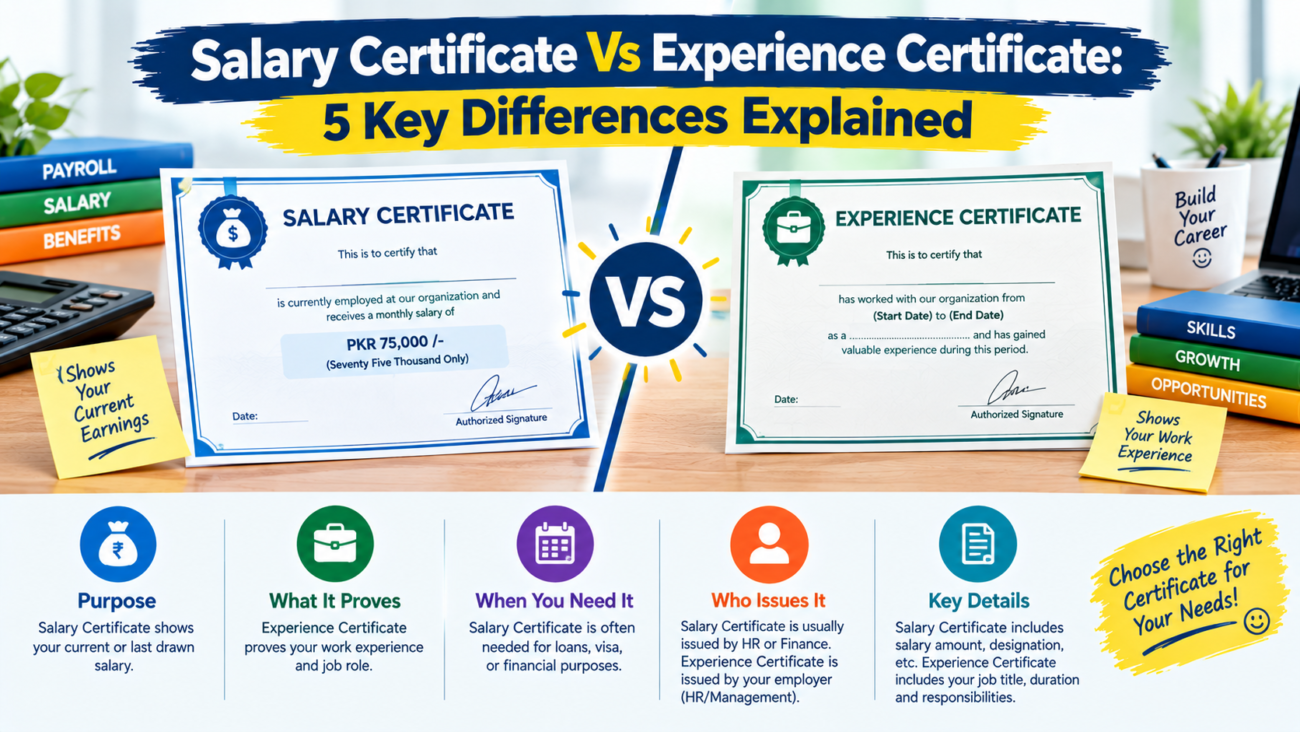
Salary Certificate Vs Experience Certificate: What’s the Real Difference
I still remember the afternoon I called my old HR department asking for “that letter that proves I worked there,” and the guy on the phone asked me back, “Which one — salary certificate or experience certificate?” I genuinely didn’t know there was a difference. I thought a piece of paper with the company letterhead and my name on it was all that mattered. Turns out, it mattered a lot which one I actually needed, and getting it wrong cost me an extra week of back-and-forth emails right when I was trying to close a car loan.
If you’ve ever been stuck in that same confusion, you’re not alone. The whole salary certificate vs experience certificate mix-up is one of the most common HR headaches people run into, usually at the worst possible time — when a bank, an embassy, or a new employer is waiting on you.

Why People Mix These Two Up So Easily
Both documents come from the same place (your HR department), both sit on company letterhead, and both have your name and designation printed at the top. From a distance, they look like twins. That’s exactly why the salary certificate vs experience certificate confusion keeps happening — nobody explains the actual purpose difference until you’re already stuck needing one.
Here’s the simple way to remember it: one proves what you earn, the other proves what you did.
What a Salary Certificate Actually Covers
A salary certificate is basically a financial snapshot. It states your current (or last-drawn) salary breakdown — basic pay, allowances, sometimes bonuses — and confirms that you’re employed, or were employed, at a certain pay level.
Banks ask for this constantly. When I applied for a car loan a few years back, the finance officer didn’t care at all about my job title or what I did day-to-day. She wanted one thing: proof that my monthly income could cover the installment. A salary certificate answered that in one page.
You’ll usually need a salary certificate for:
- Bank loans (car, home, personal)
- Credit card applications
- Visa applications where income proof is required
- Rental agreements in cities where landlords ask for income verification
- Opening certain types of bank accounts
What an Experience Certificate Actually Covers
An experience certificate is a completely different animal. It doesn’t care much about money — it cares about your work history. It states your job title, the department you worked in, your tenure (start and end dates), and sometimes a short note about your responsibilities or conduct.
This is the document new employers actually want when you’re switching jobs. I learned this the hard way during my first job switch — I proudly handed over a salary certificate thinking it would “prove my experience,” and the new HR person politely told me that’s not what they needed. They wanted confirmation of my role and duration, not my paycheck.
You’ll usually need an experience certificate for:
- Applying to a new job (almost always requested during onboarding)
- Professional registrations or licensing bodies
- Higher education applications abroad that ask for work history
- Building your resume credibility when a recruiter wants to verify your claims
The Core Difference, in One Line
If someone’s asking “how much do you earn,” you need a salary certificate. If someone’s asking “what did you actually do and for how long,” you need an experience certificate. That’s the entire salary certificate vs experience certificate decision in a nutshell.
A Mistake I See People Make Constantly
Here’s something that trips up a lot of people, myself included at one point: assuming one document can substitute for the other. It can’t, and most HR departments or banks won’t accept it as a substitute either.
I once watched a coworker try to use his salary certificate as proof of experience when applying for a professional certification exam. The certifying body rejected it outright because the document didn’t mention his job title, responsibilities, or how long he’d actually been working in that specific role. He had to go back to HR, explain the situation again, and wait another few days for the correct document. A completely avoidable delay if he’d known the salary certificate vs experience certificate difference going in.
How to Request the Right One (Step-by-Step)
Once the salary certificate vs experience certificate distinction clicks, requesting the correct document from HR becomes a lot less stressful.
Here’s the approach that’s actually worked for me every time since that first confusing phone call:
- Figure out exactly who’s asking and why. A bank loan officer, an embassy, and a new employer all want different things. Before you request anything from HR, know your end purpose.
- Name the document specifically in your request. Don’t just email HR saying “please issue my certificate.” Say clearly: “I need a salary certificate for a bank loan application” or “I need an experience certificate for a new job offer.”
- Mention the format requirements upfront. Some banks want the salary certificate addressed directly to them, not a generic “to whomsoever it may concern.” Saves you a second round trip.
- Give HR a realistic timeline. Most companies take two to five working days to issue either document, especially if it needs sign-off from a manager or director.
- Double-check before you walk away. Confirm your designation, dates, and salary figures (if applicable) are accurate on the document before you leave the HR office or close the email thread.
A Quick Real-World Example
A friend of mine was applying for a UK work visa a while back. The visa requirements explicitly listed both documents — a salary certificate to prove financial stability and an experience certificate to prove her professional background matched the job offer she’d received. She assumed one combined letter would work, submitted just the experience certificate, and got a query back from the visa office asking for income proof separately. Two completely different documents, two completely different jobs to do — a textbook case of why the salary certificate vs experience certificate difference actually matters in real situations, not just on paper.
Common Mistakes to Avoid
A few patterns that keep showing up when people get this wrong:
- Asking HR for “a certificate” without specifying which one — you’ll often get whichever one the HR person assumes you mean
- Submitting a salary certificate when an employer specifically asked for proof of your role and responsibilities
- Submitting an experience certificate to a bank that actually needed your income figures
- Not checking whether the requesting party wants the document addressed to them by name (common with banks and embassies)
- Waiting until the deadline is close before requesting either document, when HR processing genuinely takes a few days
Final Thoughts
Once you actually sit down and compare them side by side, the salary certificate vs experience certificate confusion stops being confusing at all. One is about money, the other is about your work history, and knowing which one you need before you ask HR saves you the exact kind of delay I ran into with my car loan.
If you’re already dealing with HR paperwork and want to get the rest of your employment documents sorted too, it’s worth reading through experience letter vs relieving letter next, since that’s usually the next point of confusion once people get past this one.
And if you want a second reference point before requesting anything, Indeed’s guide on employment verification letters breaks down a few related document types worth knowing about too.
Next time someone asks you for “that letter from your company,” you’ll know exactly which one to ask HR for — and you won’t lose a week waiting on the wrong one like I did.
