
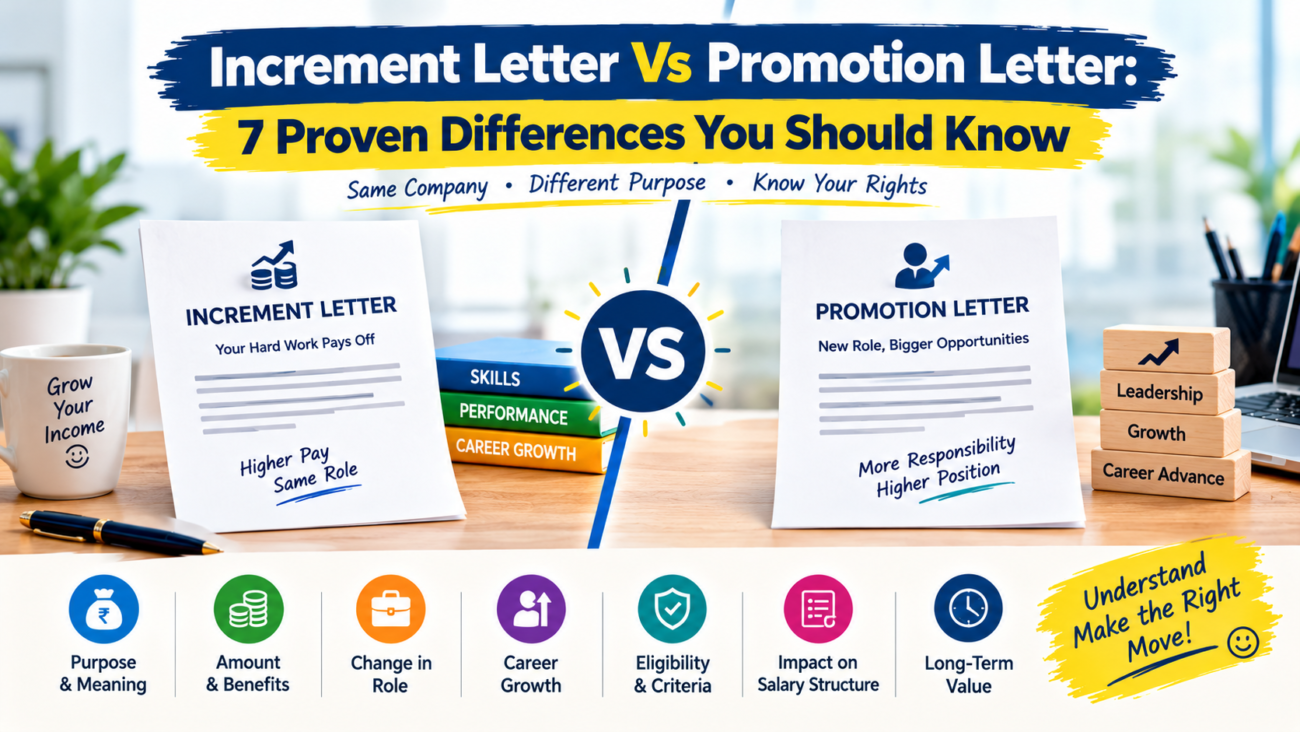
Increment Letter Vs Promotion Letter: 7 Proven Differences You Should Know
A couple of years back, I got called into my manager’s office and told I was “moving up.” I walked out thrilled, texted my family that I’d been promoted, and spent the whole evening celebrating. Then the actual letter arrived a week later — and it only mentioned a salary increase. No new title. No change in reporting line. Nothing about added responsibilities.
I remember staring at that letter so confused. Wasn’t this supposed to be a promotion? Turns out, what I’d actually received was an increment letter, not a promotion letter, and nobody had bothered to clarify which one I was getting during that initial conversation.
That mix-up taught me something most people only learn the hard way — increment letter vs promotion letter isn’t just a wording difference. They’re two completely separate documents, triggered by different reasons, and confusing them can lead to some pretty awkward conversations with friends and family after you’ve already announced the “wrong” news.

Increment Letter Vs Promotion Letter: What I Thought vs What Actually Happened
Here’s the embarrassing part. I genuinely believed getting more money automatically meant my job title had changed too. In my head, salary and designation were basically the same conversation.
It took a second meeting with HR, where I politely asked “so what’s my new designation,” for things to get clarified. The HR rep looked a little surprised and explained that this round was purely a performance-based raise. My designation hadn’t changed at all. That’s when the increment letter vs promotion letter distinction actually clicked for me.
Breaking It Down Simply
Increment Letter:
- Confirms a raise in your salary
- Usually issued annually, or after a strong performance review cycle
- Your job title, responsibilities, and reporting structure stay exactly the same
- Often comes with a short note on performance metrics that justified the raise
Promotion Letter:
- Confirms a change in your designation or role level
- May or may not come with an immediate salary bump (sometimes the raise follows a few months later)
- Usually includes new responsibilities, a new reporting structure, or management of a team
- Signals a shift in your career trajectory within the company, not just your paycheck
The core of increment letter vs promotion letter really comes down to this: one rewards your current work, the other changes what your work actually is.
Why Companies Separate These Two Things
At first I thought this separation was unnecessarily complicated. Why not just combine them? But after talking to a few HR friends, I understood the logic.
Companies budget for salary increments and promotions very differently. Increments are usually tied to annual appraisal cycles and performance scores — fairly predictable, fairly formulaic. Promotions depend on open positions, team restructuring, or leadership decisions, which don’t follow a fixed calendar the same way.
So a company might give you a solid increment letter this year because you performed well, while your promotion gets delayed simply because there’s no open senior role for you to move into yet. It’s not personal — it’s structural.
A friend of mine at a different company ran into the exact same thing, two strong increment letters in a row with glowing feedback each time, but no promotion conversation even started until a senior role finally opened up on her team almost a year later.
A Mistake That Cost Me Some Awkward Conversations
Because I assumed “moving up” meant promotion, I told a few colleagues I’d been “promoted” before I even saw the paperwork. When the increment letter arrived without any designation change, I had to quietly walk that back in later conversations. A few people even asked “wait, so are you still the same position?” — which was more embarrassing than it needed to be.
The lesson here: never assume which one you’re getting based on a verbal conversation alone. Always wait for the actual letter, read exactly what it confirms, and then share the news accordingly.
Step-By-Step: How To Know Which Letter You’re Getting (Increment Letter Vs Promotion Letter)
- Don’t celebrate based on a verbal mention alone. HR conversations can be vague on purpose, especially if final approvals are still pending.
- Read the letter’s first paragraph carefully. Increment letters almost always lead with a salary figure. Promotion letters almost always lead with a new designation or title.
- Check for a reporting line change. If your manager’s name or your team structure shifted, that’s a strong promotion signal, not just an increment.
- Look for added responsibilities listed. Increment letters rarely list new duties. Promotion letters often do.
- If you’re still unsure, just ask HR directly: “Is this a salary increment only, or does this include a designation change?” It’s a completely normal question to ask, and far better than guessing.
Real Examples From My Own Career
In one company, I got an increment letter for two years straight — same title, same team, steadily increasing salary. It felt good, but I eventually realized I needed to actively ask for a promotion conversation separately, since it clearly wasn’t going to happen automatically just from strong annual reviews.
In a later role, I got a promotion letter that initially had no salary change attached at all — just a new title and a small team to manage. The pay increase came three months later in a separate increment letter once my new role’s budget was finalized. That gap confused me until I understood this was intentional, not a mistake or delay on HR’s part.
Looking back, I wish I’d asked upfront whether the salary adjustment and the title change were being processed on the same timeline, it would have saved me a confused follow-up email to HR a few weeks in.
Common Mistakes To Avoid
- Assuming a salary raise automatically means a title change (it usually doesn’t).
- Announcing a “promotion” to others before actually confirming it in writing.
- Not asking HR to clarify which type of letter you’re receiving when the conversation feels vague.
- Expecting increment and promotion to always arrive together — they frequently don’t.
- Forgetting to negotiate separately for each — a good increment doesn’t mean you shouldn’t still advocate for a promotion conversation, and vice versa.
How This Connects To Your Performance Review
If you’re heading into an appraisal cycle and trying to understand how these documents fit into the bigger picture, it’s worth reading my Appraisal Letter Vs Increment Letter guide as well, since both topics tend to come up around the same review period.
For a broader, more global perspective on how performance-based compensation decisions typically work, SHRM’s resources on compensation are a solid reference if you want the formal HR angle beyond just the South Asian workplace context.
My Honest Take
Nobody explains increment letter vs promotion letter clearly when these conversations happen — HR meetings are often vague on purpose until paperwork is finalized, and that vagueness is exactly where confusion like mine happens. If you’re waiting on either letter right now, hold off on the celebratory texts until you’ve actually read what it confirms. Trust me, it saves you a few awkward follow-up conversations later.
